
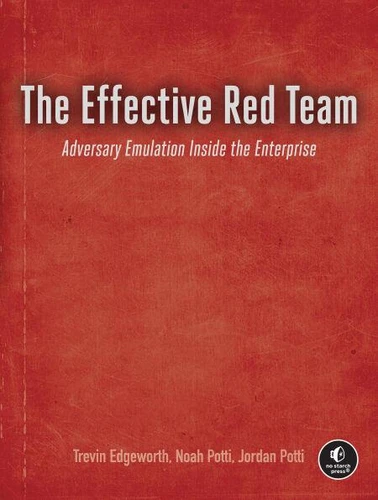
The Effective Red Team. Adversary Emulation Inside the Enterprise
Par : , ,Formats :
Disponible dans votre compte client Decitre ou Furet du Nord dès validation de votre commande. Le format ePub est :
- Compatible avec une lecture sur My Vivlio (smartphone, tablette, ordinateur)
- Compatible avec une lecture sur liseuses Vivlio
- Pour les liseuses autres que Vivlio, vous devez utiliser le logiciel Adobe Digital Edition. Non compatible avec la lecture sur les liseuses Kindle, Remarkable et Sony
 , qui est-ce ?
Notre partenaire de plateforme de lecture numérique où vous retrouverez l'ensemble de vos ebooks gratuitement
Pour en savoir plus sur nos ebooks, consultez notre aide en ligne ici
C'est si simple ! Lisez votre ebook avec l'app Vivlio sur votre tablette, mobile ou ordinateur :

- Nombre de pages504
- Date de parution16/02/2027
- FormatePub
- ISBN978-1-7185-0511-7
- EAN9781718505117
- Protection num.pas de protection
- Infos supplémentairesepub
- ÉditeurNo Starch Press
Résumé
A practitioner-written guide to building, operating, and sustaining a red team inside a real organization, showing security leaders and senior operators how to turn adversary simulation into a valued capability the business relies on to strengthen its resilience against the threats it faces. Most red team efforts fail to make the lasting impact they are capable of, and the root cause is rarely the shortage of technical skill.
More commonly, red teams fail because they cannot survive the realities of enterprise environments. The Effective Red Team moves past tools, syntax and exploits, to focus on what makes adversary simulation invaluable at scale, including sound design, disciplined operations, stakeholder alignment, and clear communication of impact. Written by leaders who have built and run red teams inside large, complex organizations, the book explains how to create a red team program that delivers sustained security improvement and plays an invaluable role within the broader security program.
Beyond teaching readers how to break in, the authors focus on adapting a program to an organization's culture, risk posture and most critical assets. Readers learn how to define purpose and scope, plan meaningful operations, partner with defenders and leadership, manage safety and risk, and translate uncomfortable findings into action. Emphasizing judgment, structure, and repeatable frameworks, teams learn the primitives and principles behind compromise so they understand both why and how they do what they do.
The result is a practical, experience-driven guide for anyone responsible for turning red teaming into a credible, trusted enterprise capability.
More commonly, red teams fail because they cannot survive the realities of enterprise environments. The Effective Red Team moves past tools, syntax and exploits, to focus on what makes adversary simulation invaluable at scale, including sound design, disciplined operations, stakeholder alignment, and clear communication of impact. Written by leaders who have built and run red teams inside large, complex organizations, the book explains how to create a red team program that delivers sustained security improvement and plays an invaluable role within the broader security program.
Beyond teaching readers how to break in, the authors focus on adapting a program to an organization's culture, risk posture and most critical assets. Readers learn how to define purpose and scope, plan meaningful operations, partner with defenders and leadership, manage safety and risk, and translate uncomfortable findings into action. Emphasizing judgment, structure, and repeatable frameworks, teams learn the primitives and principles behind compromise so they understand both why and how they do what they do.
The result is a practical, experience-driven guide for anyone responsible for turning red teaming into a credible, trusted enterprise capability.