
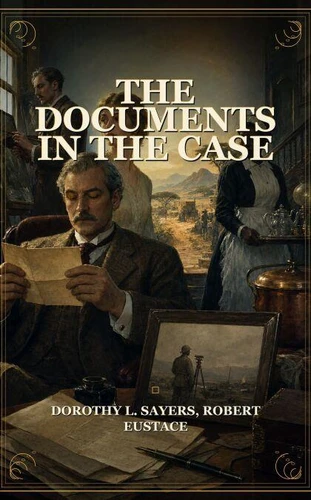
The Documents In The Case
Par :Formats :
Disponible dans votre compte client Decitre ou Furet du Nord dès validation de votre commande. Le format ePub est :
- Compatible avec une lecture sur My Vivlio (smartphone, tablette, ordinateur)
- Compatible avec une lecture sur liseuses Vivlio
- Pour les liseuses autres que Vivlio, vous devez utiliser le logiciel Adobe Digital Edition. Non compatible avec la lecture sur les liseuses Kindle, Remarkable et Sony
 , qui est-ce ?
Notre partenaire de plateforme de lecture numérique où vous retrouverez l'ensemble de vos ebooks gratuitement
Pour en savoir plus sur nos ebooks, consultez notre aide en ligne ici
C'est si simple ! Lisez votre ebook avec l'app Vivlio sur votre tablette, mobile ou ordinateur :

- Nombre de pages272
- FormatePub
- ISBN978-3-542-78498-0
- EAN9783542784980
- Date de parution19/05/2026
- Protection num.Digital Watermarking
- Taille1 Mo
- Infos supplémentairesepub
- ÉditeurNahdet Misr
Résumé
The household of George Harrison and his young wife is enlivened by their new lodgers, a novelist and a painter, who nonetheless have very different effects on the Harrisons' domestic help. Mr. Harrison's son by his first wife, an engineer working in Central Africa, receives letters from his father (also an engineer, and a self-taught gourmet chef) which take on new significance when a fatality occurs.
By the time The Documents in the Case was conceived, Dorothy Sayers had already achieved fame as the creator of the Lord Peter Wimsey novels. In the Spring of 1928, she had contact with Dr. Eustace Barton , a medical doctor who had already authored some medical mysteries of his own under the pen name "Robert Eustace." Barton pitched a scientific idea for a plot, and suggested their collaboration. With her own interest in science and its intersection with philosophical questions and the life of faith, Sayers took up the proposal with enthusiasm.
The form of the book is a departure for Sayers. The epistolary novel is a very old genre, but it committed Sayers to an unusual, but potentially creative form. The first of the "documents" is dated roughly to the time when the collaboration commenced, so the plot's timeline is not far off "real time" for their writing. The scientific element-an important contribution from Barton-plays a central role in the story.
Together, Sayers and Barton conducted chemical experiments to ensure the veracity of this element of the story. Given Sayers's enthusiasm for the concepts and collaboration, she was left with regrets about the final result, not least since objections were raised to the science on which the solution rested. By the end of 1932, Dr. Barton was able to put those doubts to rest, and their solution was vindicated.
Meanwhile, the epistolary form gives a new dimension to the reader's attempt to solve the mystery, and Sayers's powerful treatment of grand themes suggest a trajectory towards some of her later work.
By the time The Documents in the Case was conceived, Dorothy Sayers had already achieved fame as the creator of the Lord Peter Wimsey novels. In the Spring of 1928, she had contact with Dr. Eustace Barton , a medical doctor who had already authored some medical mysteries of his own under the pen name "Robert Eustace." Barton pitched a scientific idea for a plot, and suggested their collaboration. With her own interest in science and its intersection with philosophical questions and the life of faith, Sayers took up the proposal with enthusiasm.
The form of the book is a departure for Sayers. The epistolary novel is a very old genre, but it committed Sayers to an unusual, but potentially creative form. The first of the "documents" is dated roughly to the time when the collaboration commenced, so the plot's timeline is not far off "real time" for their writing. The scientific element-an important contribution from Barton-plays a central role in the story.
Together, Sayers and Barton conducted chemical experiments to ensure the veracity of this element of the story. Given Sayers's enthusiasm for the concepts and collaboration, she was left with regrets about the final result, not least since objections were raised to the science on which the solution rested. By the end of 1932, Dr. Barton was able to put those doubts to rest, and their solution was vindicated.
Meanwhile, the epistolary form gives a new dimension to the reader's attempt to solve the mystery, and Sayers's powerful treatment of grand themes suggest a trajectory towards some of her later work.
A propos de Dorothy L. Sayers
Strong Poison
E-book
0,99 €

Whose Body
E-book
0,49 €
Unnatural Death
E-book
0,49 €
Clouds Of Witness
E-book
0,49 €
Los documentos del caso
E-book
3,49 €
14,99 €

Whose Body? (Unabridged)
Audiobook
2,99 €