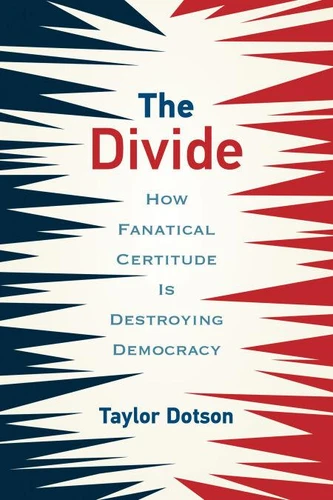
The Divide. How Fanatical Certitude Is Destroying Democracy
Par :Formats :
Disponible dans votre compte client Decitre ou Furet du Nord dès validation de votre commande. Le format ePub protégé est :
- Compatible avec une lecture sur My Vivlio (smartphone, tablette, ordinateur)
- Compatible avec une lecture sur liseuses Vivlio
- Pour les liseuses autres que Vivlio, vous devez utiliser le logiciel Adobe Digital Edition. Non compatible avec la lecture sur les liseuses Kindle, Remarkable et Sony
- Non compatible avec un achat hors France métropolitaine
 , qui est-ce ?
Notre partenaire de plateforme de lecture numérique où vous retrouverez l'ensemble de vos ebooks gratuitement
Pour en savoir plus sur nos ebooks, consultez notre aide en ligne ici
C'est si simple ! Lisez votre ebook avec l'app Vivlio sur votre tablette, mobile ou ordinateur :

- Nombre de pages240
- FormatePub
- ISBN978-0-262-36598-7
- EAN9780262365987
- Date de parution03/08/2021
- Protection num.Adobe DRM
- Taille478 Ko
- Infos supplémentairesepub
- ÉditeurThe MIT Press
Résumé
Why our obsession with truth--the idea that some undeniable truth will make politics unnecessary--is driving our political polarization. In The Divide, Taylor Dotson argues provocatively that what drives political polarization is not our disregard for facts in a post-truth era, but rather our obsession with truth. The idea that some undeniable truth will make politics unnecessary, Dotson says, is damaging democracy.
We think that appealing to facts, or common sense, or nature, or the market will resolve political disputes. We view our opponents as ignorant, corrupt, or brainwashed. Dotson argues that we don't need to agree with everyone, or force everyone to agree with us; we just need to be civil enough to practice effective politics. Dotson shows that we are misguided to pine for a lost age of respect for expertise.
For one thing, such an age never happened. For another, people cannot be made into ultra-rational Vulcans. Dotson offers a road map to guide both citizens and policy makers in rethinking and refashioning political interactions to be more productive. To avoid the trap of divisive and fanatical certitude, we must stop idealizing expert knowledge and romanticizing common sense. He outlines strategies for making political disputes more productive: admitting uncertainty, sharing experiences, and tolerating and negotiating disagreement.
He suggests reforms to political practices and processes, adjustments to media systems, and dramatic changes to schooling, childhood, the workplace, and other institutions. Productive and intelligent politics is not a product of embracing truth, Dotson argues, but of adopting a pluralistic democratic process.
We think that appealing to facts, or common sense, or nature, or the market will resolve political disputes. We view our opponents as ignorant, corrupt, or brainwashed. Dotson argues that we don't need to agree with everyone, or force everyone to agree with us; we just need to be civil enough to practice effective politics. Dotson shows that we are misguided to pine for a lost age of respect for expertise.
For one thing, such an age never happened. For another, people cannot be made into ultra-rational Vulcans. Dotson offers a road map to guide both citizens and policy makers in rethinking and refashioning political interactions to be more productive. To avoid the trap of divisive and fanatical certitude, we must stop idealizing expert knowledge and romanticizing common sense. He outlines strategies for making political disputes more productive: admitting uncertainty, sharing experiences, and tolerating and negotiating disagreement.
He suggests reforms to political practices and processes, adjustments to media systems, and dramatic changes to schooling, childhood, the workplace, and other institutions. Productive and intelligent politics is not a product of embracing truth, Dotson argues, but of adopting a pluralistic democratic process.