
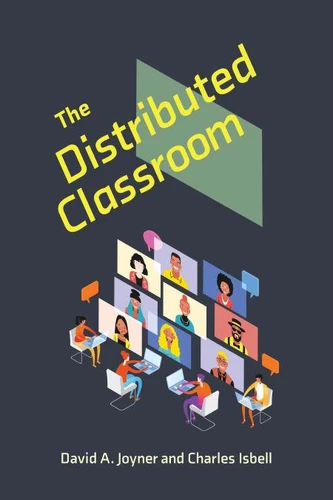
The Distributed Classroom
Par : ,Formats :
Disponible dans votre compte client Decitre ou Furet du Nord dès validation de votre commande. Le format ePub protégé est :
- Compatible avec une lecture sur My Vivlio (smartphone, tablette, ordinateur)
- Compatible avec une lecture sur liseuses Vivlio
- Pour les liseuses autres que Vivlio, vous devez utiliser le logiciel Adobe Digital Edition. Non compatible avec la lecture sur les liseuses Kindle, Remarkable et Sony
- Non compatible avec un achat hors France métropolitaine
 , qui est-ce ?
Notre partenaire de plateforme de lecture numérique où vous retrouverez l'ensemble de vos ebooks gratuitement
Pour en savoir plus sur nos ebooks, consultez notre aide en ligne ici
C'est si simple ! Lisez votre ebook avec l'app Vivlio sur votre tablette, mobile ou ordinateur :

- Nombre de pages360
- FormatePub
- ISBN978-0-262-36655-7
- EAN9780262366557
- Date de parution14/09/2021
- Protection num.Adobe DRM
- Taille448 Ko
- Infos supplémentairesepub
- ÉditeurThe MIT Press
Résumé
A vision of the future of education in which the classroom experience is distributed across space and time without compromising learning. What if there were a model for learning in which the classroom experience was distributed across space and time--and students could still have the benefits of the traditional classroom, even if they can't be present physically or learn synchronously? In this book, two experts in online learning envision a future in which education from kindergarten through graduate school need not be tethered to a single physical classroom.
The distributed classroom would neither sacrifice students' social learning experience nor require massive development resources. It goes beyond hybrid learning, so ubiquitous during the COVID-19 pandemic, and MOOCs, so trendy a few years ago, to reimagine the classroom itself. David Joyner and Charles Isbell, both of Georgia Tech, explain how recent developments, including distance learning and learning management systems, have paved the way for the distributed classroom.
They propose that we dispense with the dichotomy between online and traditional education, and the assumption that online learning is necessarily inferior. They describe the distributed classroom's various delivery modes for in-person students, remote synchronous students, and remote asynchronous students; the goal would be a symmetry of experiences, with both students and teachers able to move from one mode to another.
With The Distributed Classroom, Joyner and Isbell offer an optimistic, learner-centric view of the future of education, in which every person on earth is turned into a potential learner as barriers of cost, geography, and synchronicity disappear.
The distributed classroom would neither sacrifice students' social learning experience nor require massive development resources. It goes beyond hybrid learning, so ubiquitous during the COVID-19 pandemic, and MOOCs, so trendy a few years ago, to reimagine the classroom itself. David Joyner and Charles Isbell, both of Georgia Tech, explain how recent developments, including distance learning and learning management systems, have paved the way for the distributed classroom.
They propose that we dispense with the dichotomy between online and traditional education, and the assumption that online learning is necessarily inferior. They describe the distributed classroom's various delivery modes for in-person students, remote synchronous students, and remote asynchronous students; the goal would be a symmetry of experiences, with both students and teachers able to move from one mode to another.
With The Distributed Classroom, Joyner and Isbell offer an optimistic, learner-centric view of the future of education, in which every person on earth is turned into a potential learner as barriers of cost, geography, and synchronicity disappear.