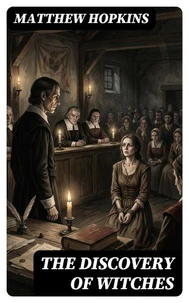
The Discovery of Witches
Par :Formats :
Disponible dans votre compte client Decitre ou Furet du Nord dès validation de votre commande. Le format ePub est :
- Compatible avec une lecture sur My Vivlio (smartphone, tablette, ordinateur)
- Compatible avec une lecture sur liseuses Vivlio
- Pour les liseuses autres que Vivlio, vous devez utiliser le logiciel Adobe Digital Edition. Non compatible avec la lecture sur les liseuses Kindle, Remarkable et Sony
 , qui est-ce ?
Notre partenaire de plateforme de lecture numérique où vous retrouverez l'ensemble de vos ebooks gratuitement
Pour en savoir plus sur nos ebooks, consultez notre aide en ligne ici
C'est si simple ! Lisez votre ebook avec l'app Vivlio sur votre tablette, mobile ou ordinateur :

- Nombre de pages56
- FormatePub
- ISBN978-4-935268-12-4
- EAN9784935268124
- Date de parution04/05/2026
- Protection num.Digital Watermarking
- Taille139 Ko
- Infos supplémentairesepub
- ÉditeurCLXBX
Résumé
The Discovery of Witches by Matthew Hopkins is a historically significant and controversial treatise that reflects the intense fear, superstition, and religious anxiety surrounding witchcraft in seventeenth-century England. Written by one of the most infamous witch-hunters of the period, this work presents Hopkins' methods, beliefs, and justifications for identifying and prosecuting those accused of practicing witchcraft.
The text offers a detailed account of the criteria and procedures Hopkins claimed were used to expose witches, including examinations, confessions, and various forms of interrogation.
It reflects the mindset of a turbulent era in which accusations of witchcraft were often intertwined with social tension, religious fervor, and local disputes. Hopkins presents himself as a defender of moral and spiritual order, arguing that his efforts were necessary to protect communities from perceived demonic influence. Beyond its procedural descriptions, the work provides insight into the cultural and psychological landscape of early modern England.
It reveals how fear and belief systems shaped legal practices and influenced the treatment of individuals accused of supernatural crimes. The tone of the writing is assertive and uncompromising, reflecting the certainty with which Hopkins viewed his mission. Modern readers approach this text not as a guide, but as a historical artifact that sheds light on the complexities of witch trials and the broader history of persecution.
It serves as a window into the intersection of law, religion, and popular belief during a period marked by uncertainty and social unrest. The Discovery of Witches remains an important document for understanding the history of witchcraft accusations and the development of early modern legal and cultural attitudes toward the supernatural.
It reflects the mindset of a turbulent era in which accusations of witchcraft were often intertwined with social tension, religious fervor, and local disputes. Hopkins presents himself as a defender of moral and spiritual order, arguing that his efforts were necessary to protect communities from perceived demonic influence. Beyond its procedural descriptions, the work provides insight into the cultural and psychological landscape of early modern England.
It reveals how fear and belief systems shaped legal practices and influenced the treatment of individuals accused of supernatural crimes. The tone of the writing is assertive and uncompromising, reflecting the certainty with which Hopkins viewed his mission. Modern readers approach this text not as a guide, but as a historical artifact that sheds light on the complexities of witch trials and the broader history of persecution.
It serves as a window into the intersection of law, religion, and popular belief during a period marked by uncertainty and social unrest. The Discovery of Witches remains an important document for understanding the history of witchcraft accusations and the development of early modern legal and cultural attitudes toward the supernatural.