
Author
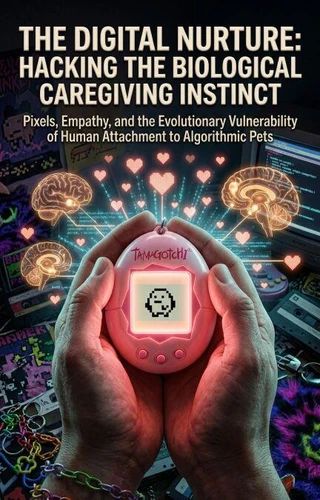
The Digital Nurture: Hacking the Biological Caregiving Instinct. Pixels, Empathy, and the Evolutionary Vulnerability of Human Attachment to Algorithmic Pets
Par :Formats :
Disponible dans votre compte client Decitre ou Furet du Nord dès validation de votre commande. Le format ePub est :
- Compatible avec une lecture sur My Vivlio (smartphone, tablette, ordinateur)
- Compatible avec une lecture sur liseuses Vivlio
- Pour les liseuses autres que Vivlio, vous devez utiliser le logiciel Adobe Digital Edition. Non compatible avec la lecture sur les liseuses Kindle, Remarkable et Sony
 , qui est-ce ?
Notre partenaire de plateforme de lecture numérique où vous retrouverez l'ensemble de vos ebooks gratuitement
Pour en savoir plus sur nos ebooks, consultez notre aide en ligne ici
C'est si simple ! Lisez votre ebook avec l'app Vivlio sur votre tablette, mobile ou ordinateur :

- Nombre de pages163
- FormatePub
- ISBN978-3-565-34770-4
- EAN9783565347704
- Date de parution22/03/2026
- Protection num.pas de protection
- Taille786 Ko
- Infos supplémentairesepub
- ÉditeurEmphaloz Publishing House
Résumé
In 1996, the world witnessed an unprecedented psychological phenomenon. Millions of people, from children to corporate executives, became intensely, genuinely emotionally attached to a low-resolution clump of black pixels on a tiny keychain screen. When their Tamagotchis "died, " owners experienced real grief.
This bizarre fad was not a marketing accident; it was a masterful hack of human biology.
Evolution has hardwired our brains to respond to specific caregiving triggers-hunger cries, vulnerability, and the demand for attention. The Tamagotchi's simple algorithm perfectly mimicked these distress signals, bypassing logic and directly triggering the release of oxytocin in the human brain. This book dissects the mechanics of digital empathy. It explores how easily our deepest evolutionary instincts can be hijacked by basic programming, forcing us to project consciousness and love onto cold silicon. Understand the fascinating psychology of why we nurture the artificial, and what our bond with digital pets reveals about the desperate human need to care for others.
Evolution has hardwired our brains to respond to specific caregiving triggers-hunger cries, vulnerability, and the demand for attention. The Tamagotchi's simple algorithm perfectly mimicked these distress signals, bypassing logic and directly triggering the release of oxytocin in the human brain. This book dissects the mechanics of digital empathy. It explores how easily our deepest evolutionary instincts can be hijacked by basic programming, forcing us to project consciousness and love onto cold silicon. Understand the fascinating psychology of why we nurture the artificial, and what our bond with digital pets reveals about the desperate human need to care for others.