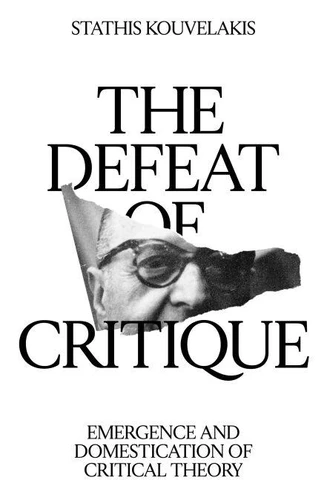
The Defeat of Critique. Emergence and Domestication of Critical Theory
Par :Formats :
Disponible dans votre compte client Decitre ou Furet du Nord dès validation de votre commande. Le format ePub protégé est :
- Compatible avec une lecture sur My Vivlio (smartphone, tablette, ordinateur)
- Compatible avec une lecture sur liseuses Vivlio
- Pour les liseuses autres que Vivlio, vous devez utiliser le logiciel Adobe Digital Edition. Non compatible avec la lecture sur les liseuses Kindle, Remarkable et Sony
- Non compatible avec un achat hors France métropolitaine
 , qui est-ce ?
Notre partenaire de plateforme de lecture numérique où vous retrouverez l'ensemble de vos ebooks gratuitement
Pour en savoir plus sur nos ebooks, consultez notre aide en ligne ici
C'est si simple ! Lisez votre ebook avec l'app Vivlio sur votre tablette, mobile ou ordinateur :

- Nombre de pages688
- Date de parution04/05/2027
- FormatePub
- ISBN978-1-80429-545-8
- EAN9781804295458
- Protection num.Adobe DRM
- Infos supplémentairesepub
- ÉditeurVerso
Résumé
A essential perspective on Critical Theory, painting the decline of its initial radical potential and the necessity of reviving it. How did a theoretical project that started as a radical rethinking of Marxism, responding to the defeat of the Left in the face of Nazism, lose its radical potential? Tracing the intellectual trajectory of three major figures--Horkheimer, Habermas and Honneth--The Defeat of Critique tells a new story of the formation and evolution of Critical Theory. Faced with the isolation of exile and the failure of the anti-fascist fronts, Horkheimer broke with his founding project and turned towards a negative philosophy of history.
The coming of the next generations of the Frankfurt School allowed for a renewal of the theoretical ambition but at a high price: critique had to adapt to the order of post-war West Germany. With Habermas, critique aims to expand a public space, ignoring the contradictions of social relations; with Honneth, it becomes a therapy of the social, aiming at repairing a world instead of transforming it.
From one generation to the next, Critical Theory has turned its back on the analysis of the regressive potential inherent in capitalist modernity. But its initial project has still significant resources to offer for an understanding of the present and for the emancipatory struggles of our time. To recapture its revolutionary potential, critical theory needs to return to its initial project and cross-fertilize it with other currents within Marxism and radical thought.
The coming of the next generations of the Frankfurt School allowed for a renewal of the theoretical ambition but at a high price: critique had to adapt to the order of post-war West Germany. With Habermas, critique aims to expand a public space, ignoring the contradictions of social relations; with Honneth, it becomes a therapy of the social, aiming at repairing a world instead of transforming it.
From one generation to the next, Critical Theory has turned its back on the analysis of the regressive potential inherent in capitalist modernity. But its initial project has still significant resources to offer for an understanding of the present and for the emancipatory struggles of our time. To recapture its revolutionary potential, critical theory needs to return to its initial project and cross-fertilize it with other currents within Marxism and radical thought.