In recent years, a growing number of voices within the Body of Christ (Messiah) have begun to re-examine the doctrine of giving under the New Covenant. While their conclusions may vary, many converge on a central truth: giving must no longer be driven by obligation, fear, or transaction, but by grace, freedom, and love. This work was not born in isolation. At a certain point in my journey, I was deeply impacted by the revolutionary teaching of Creflo Dollar concerning the tithe and the doctrine of giving under the New Covenant.
His message challenged many traditional assumptions and emphasized grace, freedom from legal obligation, and the need to re-examine giving in the light of Christ's finished work. This stirred within me a deeper search-not toward opinions, but toward Scripture. What began as reflection became prayer, and what was carried in prayer gradually unfolded into the message contained in these pages. From the earliest pages of Scripture, giving has been central to the relationship between humanity and Elohim-an expression of devotion, gratitude, and reverence.
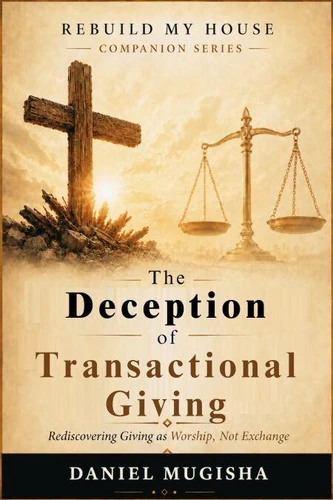
Yet alongside this sacred practice, a subtle distortion has emerged, transforming giving from an act of worship into a form of exchange. It is often presented as a principle of guaranteed return: give to receive, sow to reap, invest to be blessed. While such language may contain elements of truth, it has, in many cases, shifted the focus from Elohim to personal gain. What was once surrender has become strategy.
This shift introduces a serious misconception: that giving can operate independently of the condition of the heart or the alignment of the life with God. In such a framework, generosity is treated as a universal law rather than a covenant expression, reducing worship to transaction. Scripture consistently reveals otherwise. Elohim has never been concerned merely with the act of giving, but with the heart behind it.
Offerings were rejected when accompanied by disobedience and hypocrisy, for "to obey is better than sacrifice" (1 Samuel 15:22). The prophets rebuked those who gave outwardly while living contrary to God's ways, showing that giving, in itself, does not secure divine approval. Christ reaffirmed this principle. He did not abolish giving, but exposed its motives, emphasizing that justice, mercy, and faith must not be neglected (Matthew 23:23).
He removed every sense of entitlement, teaching that even in obedience, the servant claims no merit before God (Luke 17:10). The early Church followed this same pattern. Giving was generous and sacrificial, yet never presented as a means of securing blessing. It flowed from love, unity, and devotion, not from expectation or exchange. This book does not seek to diminish giving, but to restore it-to its rightful place as worship, alignment, and participation in the purposes of God.
It addresses the growing confusion that equates giving with guaranteed return, often without regard for truth, righteousness, or obedience. To do this, we return to the foundations of Scripture: giving before the Law, the role of the tithe under the Mosaic covenant, and the prophetic rebukes that reveal God's true concern. We will also examine key passages, such as Malachi 3, in their proper context.
The goal is not controversy, but clarity. Not accusation, but alignment. For when giving is rightly understood, it is no longer driven by fear, pressure, or expectation, but by truth, freedom, and devotion. It ceases to be a transaction-and becomes what it was always meant to be: worship.
In recent years, a growing number of voices within the Body of Christ (Messiah) have begun to re-examine the doctrine of giving under the New Covenant. While their conclusions may vary, many converge on a central truth: giving must no longer be driven by obligation, fear, or transaction, but by grace, freedom, and love. This work was not born in isolation. At a certain point in my journey, I was deeply impacted by the revolutionary teaching of Creflo Dollar concerning the tithe and the doctrine of giving under the New Covenant.
His message challenged many traditional assumptions and emphasized grace, freedom from legal obligation, and the need to re-examine giving in the light of Christ's finished work. This stirred within me a deeper search-not toward opinions, but toward Scripture. What began as reflection became prayer, and what was carried in prayer gradually unfolded into the message contained in these pages. From the earliest pages of Scripture, giving has been central to the relationship between humanity and Elohim-an expression of devotion, gratitude, and reverence.
Yet alongside this sacred practice, a subtle distortion has emerged, transforming giving from an act of worship into a form of exchange. It is often presented as a principle of guaranteed return: give to receive, sow to reap, invest to be blessed. While such language may contain elements of truth, it has, in many cases, shifted the focus from Elohim to personal gain. What was once surrender has become strategy.
This shift introduces a serious misconception: that giving can operate independently of the condition of the heart or the alignment of the life with God. In such a framework, generosity is treated as a universal law rather than a covenant expression, reducing worship to transaction. Scripture consistently reveals otherwise. Elohim has never been concerned merely with the act of giving, but with the heart behind it.
Offerings were rejected when accompanied by disobedience and hypocrisy, for "to obey is better than sacrifice" (1 Samuel 15:22). The prophets rebuked those who gave outwardly while living contrary to God's ways, showing that giving, in itself, does not secure divine approval. Christ reaffirmed this principle. He did not abolish giving, but exposed its motives, emphasizing that justice, mercy, and faith must not be neglected (Matthew 23:23).
He removed every sense of entitlement, teaching that even in obedience, the servant claims no merit before God (Luke 17:10). The early Church followed this same pattern. Giving was generous and sacrificial, yet never presented as a means of securing blessing. It flowed from love, unity, and devotion, not from expectation or exchange. This book does not seek to diminish giving, but to restore it-to its rightful place as worship, alignment, and participation in the purposes of God.
It addresses the growing confusion that equates giving with guaranteed return, often without regard for truth, righteousness, or obedience. To do this, we return to the foundations of Scripture: giving before the Law, the role of the tithe under the Mosaic covenant, and the prophetic rebukes that reveal God's true concern. We will also examine key passages, such as Malachi 3, in their proper context.
The goal is not controversy, but clarity. Not accusation, but alignment. For when giving is rightly understood, it is no longer driven by fear, pressure, or expectation, but by truth, freedom, and devotion. It ceases to be a transaction-and becomes what it was always meant to be: worship.


 , qui est-ce ?
