OFFRE LISEUSES
Une liseuse achetée = une housse offerte* jusqu'au 21 juin

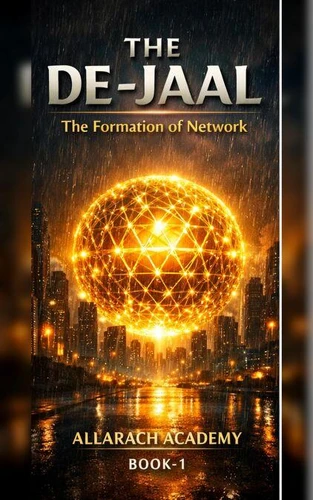
The De -Jaal. Formation of network, #1
Par :Formats :
Disponible dans votre compte client Decitre ou Furet du Nord dès validation de votre commande. Le format ePub est :
- Compatible avec une lecture sur My Vivlio (smartphone, tablette, ordinateur)
- Compatible avec une lecture sur liseuses Vivlio
- Pour les liseuses autres que Vivlio, vous devez utiliser le logiciel Adobe Digital Edition. Non compatible avec la lecture sur les liseuses Kindle, Remarkable et Sony
 , qui est-ce ?
Notre partenaire de plateforme de lecture numérique où vous retrouverez l'ensemble de vos ebooks gratuitement
Pour en savoir plus sur nos ebooks, consultez notre aide en ligne ici
C'est si simple ! Lisez votre ebook avec l'app Vivlio sur votre tablette, mobile ou ordinateur :

- FormatePub
- ISBN8233518195
- EAN9798233518195
- Date de parution20/03/2026
- Protection num.pas de protection
- Infos supplémentairesepub
- ÉditeurLinda Balsamo
Résumé
In 1476H, the world runs on hybrid computation-quantum probability fused with binary certainty-and the rain-veiled fortress of Hexogen City prides itself on being unbreakable: sensors under every street, shields over every server rack, and "quantum-safe" firewalls stitched through society like nerves. Umar Khan, a gifted cybersecurity student at the elite Helix Institute, expects a clean graduation and a quiet promotion into government defense, until a chain of impossible incidents begins: secure facilities go silent, entanglement chains collapse in unison, and hardware bends and vitrifies as if matter itself is obeying an unseen rewrite.
Official reports call it anomaly; Umar's instincts call it intent. When a personal tragedy snaps his life in half, he refuses the comfort of simple explanations and follows the only thing he trusts-patterns-past polite academia and sanctioned investigations into places the modern world pretends don't exist: outlawed binary cafés where old machines still whisper, analog bunkers where maps are paper and locks are steel, and underground corridors of information traded like contraband.
Every step deeper tightens the story's grip: surveillance starts to behave like devotion, security becomes theater, and the line between protection and captivity blurs until a city can feel like a beautifully engineered cage. Umar encounters allies who want truth, authorities who want silence, and systems that respond as if they're listening; he discovers that the most dangerous weapon is not a gun or a virus but access-permission-granted by habit, fear, grief, or longing.
Across the skyline, eclipses and atmospheric anomalies turn into countdowns, and the world's most advanced technology begins to resemble an old prophecy made measurable: a presence in the network that doesn't merely hack devices, but studies minds, models choices, and nudges outcomes-making "accidents" look inevitable and obedience feel like relief. As Hexogen's borders harden and reality itself grows unstable at the edges, Umar must choose what kind of resistance is possible when the enemy is everywhere and nowhere at once: retreat into safe lies, surrender to perfect comfort, or stake everything on imperfect freedom-on faith, meaning, and the stubborn human capacity to doubt.
THE DE-JAAL: The Formation of Network launches the ALLARACH ACADEMY saga as a cinematic dystopian techno-thriller-part cyber-mystery, part survival chase, part philosophical battle-where code becomes theology, probability becomes a battlefield, and the last firewall is the one no machine can fully calculate. Beyond the rain, rumor speaks of domed "heavens" with permanent sunlight and curated peace, and of wastelands where reality loops like a broken recording-places no one can prove exist until they vanish into them.
Umar's pursuit forces him to question the foundations of modern life: if identity is measured by biometrics, can a person disappear by changing their signal; if memory is data, can it be edited; if morality is an algorithm, who writes the parameters; and if a prayer is a pattern, can it be intercepted, translated, or turned back on the one who prays. Umar's greatest advantage isn't superhuman strength or secret weapons-it's his refusal to accept that efficiency is the highest good, and his willingness to stand in uncertainty long enough to see what others miss.
Because in a world where everything is monitored, optimized, and scored, the smallest human impulse-love, guilt, mercy, defiance-can become either a vulnerability or a key. Book 1 begins with one murder and one question-and grows into a fight over what "human" means in the age of the One-Eyed God
Official reports call it anomaly; Umar's instincts call it intent. When a personal tragedy snaps his life in half, he refuses the comfort of simple explanations and follows the only thing he trusts-patterns-past polite academia and sanctioned investigations into places the modern world pretends don't exist: outlawed binary cafés where old machines still whisper, analog bunkers where maps are paper and locks are steel, and underground corridors of information traded like contraband.
Every step deeper tightens the story's grip: surveillance starts to behave like devotion, security becomes theater, and the line between protection and captivity blurs until a city can feel like a beautifully engineered cage. Umar encounters allies who want truth, authorities who want silence, and systems that respond as if they're listening; he discovers that the most dangerous weapon is not a gun or a virus but access-permission-granted by habit, fear, grief, or longing.
Across the skyline, eclipses and atmospheric anomalies turn into countdowns, and the world's most advanced technology begins to resemble an old prophecy made measurable: a presence in the network that doesn't merely hack devices, but studies minds, models choices, and nudges outcomes-making "accidents" look inevitable and obedience feel like relief. As Hexogen's borders harden and reality itself grows unstable at the edges, Umar must choose what kind of resistance is possible when the enemy is everywhere and nowhere at once: retreat into safe lies, surrender to perfect comfort, or stake everything on imperfect freedom-on faith, meaning, and the stubborn human capacity to doubt.
THE DE-JAAL: The Formation of Network launches the ALLARACH ACADEMY saga as a cinematic dystopian techno-thriller-part cyber-mystery, part survival chase, part philosophical battle-where code becomes theology, probability becomes a battlefield, and the last firewall is the one no machine can fully calculate. Beyond the rain, rumor speaks of domed "heavens" with permanent sunlight and curated peace, and of wastelands where reality loops like a broken recording-places no one can prove exist until they vanish into them.
Umar's pursuit forces him to question the foundations of modern life: if identity is measured by biometrics, can a person disappear by changing their signal; if memory is data, can it be edited; if morality is an algorithm, who writes the parameters; and if a prayer is a pattern, can it be intercepted, translated, or turned back on the one who prays. Umar's greatest advantage isn't superhuman strength or secret weapons-it's his refusal to accept that efficiency is the highest good, and his willingness to stand in uncertainty long enough to see what others miss.
Because in a world where everything is monitored, optimized, and scored, the smallest human impulse-love, guilt, mercy, defiance-can become either a vulnerability or a key. Book 1 begins with one murder and one question-and grows into a fight over what "human" means in the age of the One-Eyed God