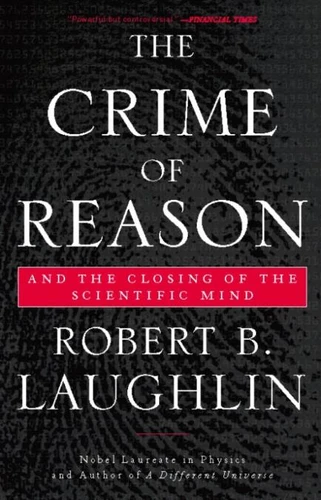
The Crime of Reason. And the Closing of the Scientific Mind
Par :Formats :
Disponible dans votre compte client Decitre ou Furet du Nord dès validation de votre commande. Le format ePub protégé est :
- Compatible avec une lecture sur My Vivlio (smartphone, tablette, ordinateur)
- Compatible avec une lecture sur liseuses Vivlio
- Pour les liseuses autres que Vivlio, vous devez utiliser le logiciel Adobe Digital Edition. Non compatible avec la lecture sur les liseuses Kindle, Remarkable et Sony
- Non compatible avec un achat hors France métropolitaine
 , qui est-ce ?
Notre partenaire de plateforme de lecture numérique où vous retrouverez l'ensemble de vos ebooks gratuitement
Pour en savoir plus sur nos ebooks, consultez notre aide en ligne ici
C'est si simple ! Lisez votre ebook avec l'app Vivlio sur votre tablette, mobile ou ordinateur :

- Nombre de pages192
- FormatePub
- ISBN978-0-7867-2631-8
- EAN9780786726318
- Date de parution22/09/2008
- Protection num.Adobe DRM
- Infos supplémentairesepub
- ÉditeurBasic Books
Résumé
We all agree that the free flow of ideas is essential to creativity. And we like to believe that in our modern, technological world, information is more freely available and flows faster than ever before. But according to Nobel Laureate Robert Laughlin, acquiring information is becoming a danger or even a crime. Increasingly, the really valuable information is private property or a state secret, with the result that it is now easy for a flash of insight, entirely innocently, to infringe a patent or threaten national security.
The public pays little attention because this vital information is "technical" -- but, Laughlin argues, information is often labeled technical so it can be sequestered, not sequestered because it's technical. The increasing restrictions on information in such fields as cryptography, biotechnology, and computer software design are creating a new Dark Age: a time characterized not by light and truth but by disinformation and ignorance.
Thus we find ourselves dealing more and more with the Crime of Reason, the antisocial and sometimes outright illegal nature of certain intellectual activities. The Crime of Reason is a reader-friendly jeremiad, On Bullshit for the Slashdot and Creative Commons crowd: a short, fiercely argued essay on a problem of increasing concern to people at the frontiers of new ideas.
The public pays little attention because this vital information is "technical" -- but, Laughlin argues, information is often labeled technical so it can be sequestered, not sequestered because it's technical. The increasing restrictions on information in such fields as cryptography, biotechnology, and computer software design are creating a new Dark Age: a time characterized not by light and truth but by disinformation and ignorance.
Thus we find ourselves dealing more and more with the Crime of Reason, the antisocial and sometimes outright illegal nature of certain intellectual activities. The Crime of Reason is a reader-friendly jeremiad, On Bullshit for the Slashdot and Creative Commons crowd: a short, fiercely argued essay on a problem of increasing concern to people at the frontiers of new ideas.