SOLDES
Jusqu'à -70% sur une sélection d'articles*

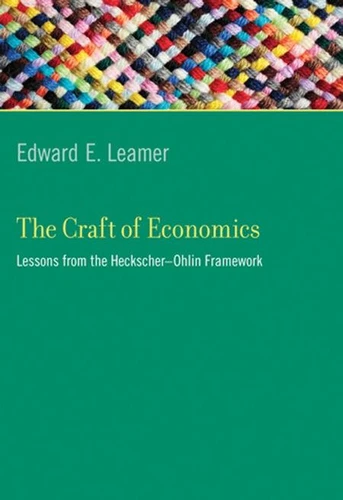
The Craft of Economics. Lessons from the Heckscher-Ohlin Framework
Par :Formats :
Disponible dans votre compte client Decitre ou Furet du Nord dès validation de votre commande. Le format ePub protégé est :
- Compatible avec une lecture sur My Vivlio (smartphone, tablette, ordinateur)
- Compatible avec une lecture sur liseuses Vivlio
- Pour les liseuses autres que Vivlio, vous devez utiliser le logiciel Adobe Digital Edition. Non compatible avec la lecture sur les liseuses Kindle, Remarkable et Sony
- Non compatible avec un achat hors France métropolitaine
 , qui est-ce ?
Notre partenaire de plateforme de lecture numérique où vous retrouverez l'ensemble de vos ebooks gratuitement
Pour en savoir plus sur nos ebooks, consultez notre aide en ligne ici
C'est si simple ! Lisez votre ebook avec l'app Vivlio sur votre tablette, mobile ou ordinateur :

- Nombre de pages208
- FormatePub
- ISBN978-0-262-30083-4
- EAN9780262300834
- Date de parution06/01/2012
- Protection num.Adobe DRM
- Taille3 Mo
- Infos supplémentairesepub
- ÉditeurThe MIT Press
Résumé
A review of the Heckscher-Ohlin framework prompts a noted economist to consider the methodology of economics. In this spirited and provocative book, Edward Leamer turns an examination of the Heckscher-Ohlin framework for global competition into an opportunity to consider the craft of economics: what economists do, what they should do, and what they shouldn't do. Claiming "a lifetime relationship with Heckscher-Ohlin, " Leamer argues that Bertil Ohlin's original idea offered something useful though vague and not necessarily valid; the economists who later translated his ideas into mathematical theorems offered something precise and valid but not necessarily useful.
He argues further that the best economists keep formal and informal thinking in balance. An Ohlinesque mostly prose style can let in faulty thinking and fuzzy communication; a mostly math style allows misplaced emphasis and opaque communication. Leamer writes that today's model- and math-driven economics needs more prose and less math. Leamer shows that the Heckscher-Ohlin framework is still useful, and that there is still much work to be done with it.
But he issues a caveat about economists: "What we do is not science, it's fiction and journalism." Economic theory, he writes, is fiction (stories, loosely connected to the facts); data analysis is journalism (facts, loosely connected to the stories). Rather than titling the two sections of his book Theory and Evidence, he calls them Economic Fiction and Econometric Journalism, explaining, "If you find that startling, that's good.
I am trying to keep you awake."
He argues further that the best economists keep formal and informal thinking in balance. An Ohlinesque mostly prose style can let in faulty thinking and fuzzy communication; a mostly math style allows misplaced emphasis and opaque communication. Leamer writes that today's model- and math-driven economics needs more prose and less math. Leamer shows that the Heckscher-Ohlin framework is still useful, and that there is still much work to be done with it.
But he issues a caveat about economists: "What we do is not science, it's fiction and journalism." Economic theory, he writes, is fiction (stories, loosely connected to the facts); data analysis is journalism (facts, loosely connected to the stories). Rather than titling the two sections of his book Theory and Evidence, he calls them Economic Fiction and Econometric Journalism, explaining, "If you find that startling, that's good.
I am trying to keep you awake."