SOLDES
Jusqu'à -70% sur une sélection d'articles*

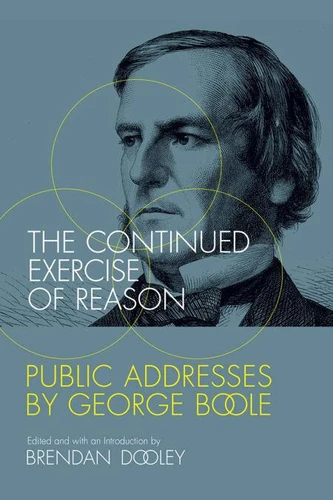
The Continued Exercise of Reason. Public Addresses by George Boole
Par :Formats :
Disponible dans votre compte client Decitre ou Furet du Nord dès validation de votre commande. Le format ePub protégé est :
- Compatible avec une lecture sur My Vivlio (smartphone, tablette, ordinateur)
- Compatible avec une lecture sur liseuses Vivlio
- Pour les liseuses autres que Vivlio, vous devez utiliser le logiciel Adobe Digital Edition. Non compatible avec la lecture sur les liseuses Kindle, Remarkable et Sony
- Non compatible avec un achat hors France métropolitaine
 , qui est-ce ?
Notre partenaire de plateforme de lecture numérique où vous retrouverez l'ensemble de vos ebooks gratuitement
Pour en savoir plus sur nos ebooks, consultez notre aide en ligne ici
C'est si simple ! Lisez votre ebook avec l'app Vivlio sur votre tablette, mobile ou ordinateur :

- Nombre de pages248
- FormatePub
- ISBN978-0-262-34558-3
- EAN9780262345583
- Date de parution27/04/2018
- Protection num.Adobe DRM
- Taille334 Ko
- Infos supplémentairesepub
- ÉditeurThe MIT Press
Résumé
Lectures, many never before published, that offer insights into the early thinking of the mathematician and polymath George Boole. George Boole (1815-1864), remembered by history as the developer of an eponymous form of algebraic logic, can be considered a pioneer of the information age not only because of the application of Boolean logic to the design of switching circuits but also because of his contributions to the mass distribution of knowledge.
In the classroom and the lecture hall, Boole interpreted recent discoveries and debates in a wide range of fields for a general audience. This collection of lectures, many never before published, offers insights into the early thinking of an innovative mathematician and intellectual polymath. Bertrand Russell claimed that "pure mathematics was discovered by Boole, " but before Boole joined a university faculty as professor of mathematics in 1849, advocacy for science and education occupied much of his time.
He was deeply committed to the Victorian ideals of social improvement and cooperation, arguing that "the continued exercise of reason" joined all disciplines in a common endeavor. In these talks, Boole discusses the genius of Isaac Newton; ancient mythologies and forms of worship; the possibility of other inhabited planets in the universe; the virtues of free and open access to knowledge; the benefits of leisure; the quality of education; the origin of scientific knowledge; and the fellowship of intellectual culture.
The lectures are accompanied by a substantive introduction by Brendan Dooley, the editor of the volume, that supplies biographical and historical context.
In the classroom and the lecture hall, Boole interpreted recent discoveries and debates in a wide range of fields for a general audience. This collection of lectures, many never before published, offers insights into the early thinking of an innovative mathematician and intellectual polymath. Bertrand Russell claimed that "pure mathematics was discovered by Boole, " but before Boole joined a university faculty as professor of mathematics in 1849, advocacy for science and education occupied much of his time.
He was deeply committed to the Victorian ideals of social improvement and cooperation, arguing that "the continued exercise of reason" joined all disciplines in a common endeavor. In these talks, Boole discusses the genius of Isaac Newton; ancient mythologies and forms of worship; the possibility of other inhabited planets in the universe; the virtues of free and open access to knowledge; the benefits of leisure; the quality of education; the origin of scientific knowledge; and the fellowship of intellectual culture.
The lectures are accompanied by a substantive introduction by Brendan Dooley, the editor of the volume, that supplies biographical and historical context.