
Nouveauté
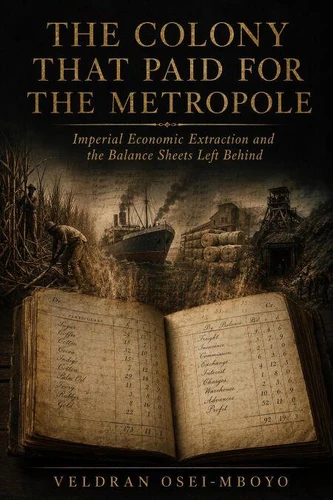
The Colony That Paid for the Metropole: Imperial Economic Extraction and the Balance Sheets Left Behind
Par :Formats :
Disponible dans votre compte client Decitre ou Furet du Nord dès validation de votre commande. Le format ePub est :
- Compatible avec une lecture sur My Vivlio (smartphone, tablette, ordinateur)
- Compatible avec une lecture sur liseuses Vivlio
- Pour les liseuses autres que Vivlio, vous devez utiliser le logiciel Adobe Digital Edition. Non compatible avec la lecture sur les liseuses Kindle, Remarkable et Sony
 , qui est-ce ?
Notre partenaire de plateforme de lecture numérique où vous retrouverez l'ensemble de vos ebooks gratuitement
Pour en savoir plus sur nos ebooks, consultez notre aide en ligne ici
C'est si simple ! Lisez votre ebook avec l'app Vivlio sur votre tablette, mobile ou ordinateur :

- FormatePub
- ISBN8235573284
- EAN9798235573284
- Date de parution30/06/2026
- Protection num.pas de protection
- Infos supplémentairesepub
- ÉditeurIoakim Ioakim
Résumé
There is a number that no one wants to say aloud. It lives in the archives of London, Paris, Amsterdam, and Brussels. It sits in the cargo manifests of merchant fleets, in the ledgers of colonial treasuries, and in the footnotes of economics textbooks that have never quite managed to explain why the world is arranged the way it is. The number is large. It is documented. And the countries that benefited from it would very much prefer that it remain a matter of academic debate rather than public reckoning.
THE COLONY THAT PAID FOR THE METROPOLE tears that number out of the footnotes and puts it where it belongs: at the center of the story. Drawing on a decade of archival research and the most rigorous quantitative scholarship in economic history, Veldran Osei-Mboyo traces the full machinery of colonial wealth transfer across four centuries and four continents. This is not a book about guilt. It is a book about accounting.
About the Indian textile industry that clothed half of Europe and was then deliberately dismantled by parliamentary tariff. About the Caribbean sugar islands that were worth more to eighteenth-century Britain than the entire North American mainland, and what happened to them after the last enslaved worker was freed and the last compensation cheque was written to the slaveowner, not the enslaved. About the Congolese rubber collectors whose severed hands became the bookkeeping of a Belgian king's personal profit margin.
About the sterling reserves sitting in London paying near-zero interest while African governments borrowed back their own wealth at market rates. The mechanisms were not random. They were designed. Every chapter of this book names the design, explains how it worked, and shows what it was worth, using real data, real records, and the kind of forensic attention to economic evidence that separates history from accusation.
For readers of Sven Beckert's Empire of Cotton, Mike Davis's Late Victorian Holocausts, and Walter Rodney's How Europe Underdeveloped Africa, this book fills the gap those works pointed toward: a single, accessible, comprehensive account of how the colonial balance sheet actually worked, from the first sugar shipments to the structural adjustment programmes that replaced the flag with a loan agreement.
The world you live in was built on a set of numbers. This book tells you what they were.
THE COLONY THAT PAID FOR THE METROPOLE tears that number out of the footnotes and puts it where it belongs: at the center of the story. Drawing on a decade of archival research and the most rigorous quantitative scholarship in economic history, Veldran Osei-Mboyo traces the full machinery of colonial wealth transfer across four centuries and four continents. This is not a book about guilt. It is a book about accounting.
About the Indian textile industry that clothed half of Europe and was then deliberately dismantled by parliamentary tariff. About the Caribbean sugar islands that were worth more to eighteenth-century Britain than the entire North American mainland, and what happened to them after the last enslaved worker was freed and the last compensation cheque was written to the slaveowner, not the enslaved. About the Congolese rubber collectors whose severed hands became the bookkeeping of a Belgian king's personal profit margin.
About the sterling reserves sitting in London paying near-zero interest while African governments borrowed back their own wealth at market rates. The mechanisms were not random. They were designed. Every chapter of this book names the design, explains how it worked, and shows what it was worth, using real data, real records, and the kind of forensic attention to economic evidence that separates history from accusation.
For readers of Sven Beckert's Empire of Cotton, Mike Davis's Late Victorian Holocausts, and Walter Rodney's How Europe Underdeveloped Africa, this book fills the gap those works pointed toward: a single, accessible, comprehensive account of how the colonial balance sheet actually worked, from the first sugar shipments to the structural adjustment programmes that replaced the flag with a loan agreement.
The world you live in was built on a set of numbers. This book tells you what they were.