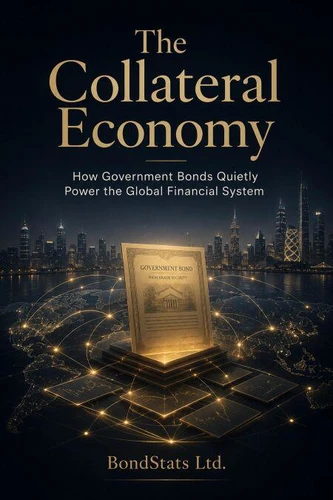
Government bonds are usually seen as investments or instruments of public borrowing. Behind that familiar market, however, lies a much larger financial system built on collateral. The Collateral Economy explains how sovereign bonds quietly support repo markets, bank liquidity, derivatives, clearing houses and central-bank operations. It shows why high-quality government securities can function almost like money inside wholesale finance, how the same collateral can circulate through several institutions, and why apparently safe assets can become central to periods of financial stress. Rather than approaching bonds as a traditional investment guide, this concise book focuses on the infrastructure beneath modern markets.
Readers will learn how repo funding works, why collateral haircuts matter, what rehypothecation means, how safe-asset shortages can emerge despite enormous government debt levels, and why a sudden dash for cash can destabilize even the deepest bond markets. Written for readers interested in bonds, banking, monetary policy and the architecture of global finance, The Collateral Economy offers a compact introduction to one of the least visible but most important parts of the financial system.
Government bonds are usually seen as investments or instruments of public borrowing. Behind that familiar market, however, lies a much larger financial system built on collateral. The Collateral Economy explains how sovereign bonds quietly support repo markets, bank liquidity, derivatives, clearing houses and central-bank operations. It shows why high-quality government securities can function almost like money inside wholesale finance, how the same collateral can circulate through several institutions, and why apparently safe assets can become central to periods of financial stress. Rather than approaching bonds as a traditional investment guide, this concise book focuses on the infrastructure beneath modern markets.
Readers will learn how repo funding works, why collateral haircuts matter, what rehypothecation means, how safe-asset shortages can emerge despite enormous government debt levels, and why a sudden dash for cash can destabilize even the deepest bond markets. Written for readers interested in bonds, banking, monetary policy and the architecture of global finance, The Collateral Economy offers a compact introduction to one of the least visible but most important parts of the financial system.


 , qui est-ce ?