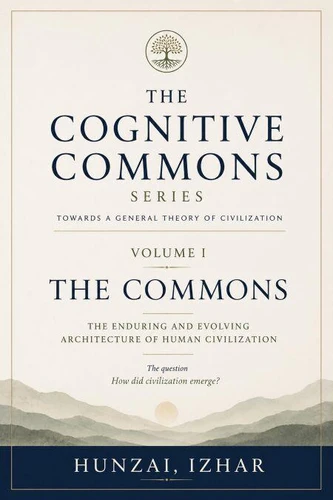
The Book is about Cmmons. It is a shared resource governed by a community through agreed rules, institutions and responsibilities that enable present and future generations to benefit from it. The defining feature of a commons is therefore governance, not ownership. A forest, irrigation system, library, scientific database or digital platform becomes a commons only when people cooperate to steward it collectively.
Commons differ from open access, where anyone may use a resource without effective rules, often leading to overuse. They also differ from private property, where decisions are made primarily by individual owners. Over time, the idea of the commons has expanded beyond natural resources to include knowledge, science, digital infrastructure and shared systems of learning. This broader understanding forms the foundation of this book.
Viewed through this broader lens, the Commons are older than markets, governments, religions, and even agriculture. They emerged with humanity itself. Long before cities were built or states were established, our ancestors depended upon shared landscapes, collective knowledge, mutual trust, and cooperation for survival. Every generation inherited these shared assets, contributed to their development, and passed them forward.
Civilization itself can therefore be understood as the cumulative evolution of humanity's Commons.
The Book is about Cmmons. It is a shared resource governed by a community through agreed rules, institutions and responsibilities that enable present and future generations to benefit from it. The defining feature of a commons is therefore governance, not ownership. A forest, irrigation system, library, scientific database or digital platform becomes a commons only when people cooperate to steward it collectively.
Commons differ from open access, where anyone may use a resource without effective rules, often leading to overuse. They also differ from private property, where decisions are made primarily by individual owners. Over time, the idea of the commons has expanded beyond natural resources to include knowledge, science, digital infrastructure and shared systems of learning. This broader understanding forms the foundation of this book.
Viewed through this broader lens, the Commons are older than markets, governments, religions, and even agriculture. They emerged with humanity itself. Long before cities were built or states were established, our ancestors depended upon shared landscapes, collective knowledge, mutual trust, and cooperation for survival. Every generation inherited these shared assets, contributed to their development, and passed them forward.
Civilization itself can therefore be understood as the cumulative evolution of humanity's Commons.


 , qui est-ce ?
