
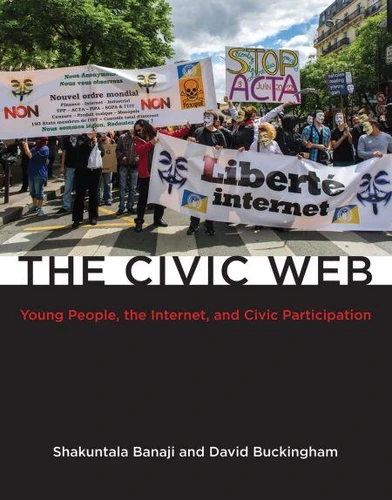
The Civic Web. Young People, the Internet, and Civic Participation
Par : ,Formats :
Disponible dans votre compte client Decitre ou Furet du Nord dès validation de votre commande. Le format ePub protégé est :
- Compatible avec une lecture sur My Vivlio (smartphone, tablette, ordinateur)
- Compatible avec une lecture sur liseuses Vivlio
- Pour les liseuses autres que Vivlio, vous devez utiliser le logiciel Adobe Digital Edition. Non compatible avec la lecture sur les liseuses Kindle, Remarkable et Sony
- Non compatible avec un achat hors France métropolitaine
 , qui est-ce ?
Notre partenaire de plateforme de lecture numérique où vous retrouverez l'ensemble de vos ebooks gratuitement
Pour en savoir plus sur nos ebooks, consultez notre aide en ligne ici
C'est si simple ! Lisez votre ebook avec l'app Vivlio sur votre tablette, mobile ou ordinateur :

- Nombre de pages208
- FormatePub
- ISBN978-0-262-31782-5
- EAN9780262317825
- Date de parution11/10/2013
- Protection num.Adobe DRM
- Taille3 Mo
- Infos supplémentairesepub
- ÉditeurThe MIT Press
Résumé
An investigation of how governments, organizations, and groups use the Internet to promote civic and political engagement among young people. There has been widespread concern in contemporary Western societies about declining engagement in civic life; people are less inclined to vote, to join political parties, to campaign for social causes, or to trust political processes. Young people in particular are frequently described as alienated or apathetic.
Some have looked optimistically to new media-and particularly the Internet-as a means of revitalizing civic life and democracy. Governments, political parties, charities, NGOs, activists, religious and ethnic groups, and grassroots organizations have created a range of youth-oriented websites that encourage widely divergent forms of civic engagement and use varying degrees of interactivity. But are young people really apathetic and lacking in motivation? Does the Internet have the power to re-engage those disenchanted with politics and civic life? Based on a major research project funded by the European Commission, this book attempts to understand the role of the Internet in promoting young people's participation.
Examples are drawn from Hungary, the Netherlands, Slovenia, Spain, Sweden, Turkey, and the United Kingdom-countries offering contrasting political systems and cultural contexts. The book also addresses broader questions about the meaning of civic engagement, the nature of new forms of participation, and their implications for the future of civic life.
Some have looked optimistically to new media-and particularly the Internet-as a means of revitalizing civic life and democracy. Governments, political parties, charities, NGOs, activists, religious and ethnic groups, and grassroots organizations have created a range of youth-oriented websites that encourage widely divergent forms of civic engagement and use varying degrees of interactivity. But are young people really apathetic and lacking in motivation? Does the Internet have the power to re-engage those disenchanted with politics and civic life? Based on a major research project funded by the European Commission, this book attempts to understand the role of the Internet in promoting young people's participation.
Examples are drawn from Hungary, the Netherlands, Slovenia, Spain, Sweden, Turkey, and the United Kingdom-countries offering contrasting political systems and cultural contexts. The book also addresses broader questions about the meaning of civic engagement, the nature of new forms of participation, and their implications for the future of civic life.