
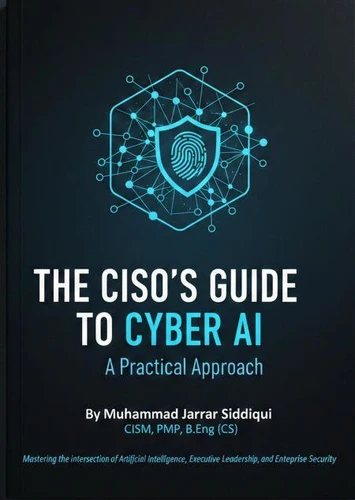
The CISO's Guide to Cyber AI: A Practical Approach
Par :Formats :
Disponible dans votre compte client Decitre ou Furet du Nord dès validation de votre commande. Le format ePub est :
- Compatible avec une lecture sur My Vivlio (smartphone, tablette, ordinateur)
- Compatible avec une lecture sur liseuses Vivlio
- Pour les liseuses autres que Vivlio, vous devez utiliser le logiciel Adobe Digital Edition. Non compatible avec la lecture sur les liseuses Kindle, Remarkable et Sony
 , qui est-ce ?
Notre partenaire de plateforme de lecture numérique où vous retrouverez l'ensemble de vos ebooks gratuitement
Pour en savoir plus sur nos ebooks, consultez notre aide en ligne ici
C'est si simple ! Lisez votre ebook avec l'app Vivlio sur votre tablette, mobile ou ordinateur :

- FormatePub
- ISBN8233604324
- EAN9798233604324
- Date de parution21/02/2026
- Protection num.pas de protection
- Infos supplémentairesepub
- ÉditeurLinda Balsamo
Résumé
The CISO's Guide to Cyber AI: A Practical ApproachBook DescriptionIn an era where cyber threats evolve faster than security teams can respond, artificial intelligence has emerged as the critical force multiplier for cybersecurity operations. The CISO's Guide to Cyber AI: A Practical Approach is the definitive handbook for security leaders navigating the complex journey from traditional security operations to AI-powered defense.
Written specifically for Chief Information Security Officers, security directors, and IT leaders, this comprehensive guide cuts through the hype and provides actionable strategies for implementing AI in cybersecurity-from initial assessment to full-scale deployment and beyond. What Makes This Book DifferentUnlike academic texts that focus on theory or vendor materials that oversell capabilities, this book provides: Real-world implementation frameworks you can use immediately Honest assessments of where AI excels and where it struggles Step-by-step roadmaps from pilot to enterprise deployment Proven ROI models to justify investments to your CFO and board Practical templates and checklists for every stage of your journey Case studies and examples from actual AI security implementations Complete vendor evaluation frameworks to avoid costly mistakes Who Should Read This BookPrimary Audience: Chief Information Security Officers (CISOs) VP/Directors of Security Operations Security Architects and Engineers SOC Managers IT Directors and CIOs overseeing security Secondary Audience: Board members and executives with cybersecurity oversight Security analysts preparing for AI-augmented roles Consultants advising on security transformation Technology leaders in heavily regulated industries What You'll LearnStrategic Planning: How to build a business-aligned AI security strategy Selecting high-ROI use cases for AI implementation Creating multi-year roadmaps that balance quick wins with long-term transformation Making build vs.
buy decisions for AI capabilities Practical Implementation: Deploying AI-powered threat detection across email, endpoints, network, and cloud Automating security operations with intelligent orchestration Implementing AI in identity and access management Measuring success with concrete KPIs and proving ROI Risk Management: Defending against adversarial AI and AI-powered attacks Establishing governance frameworks for AI systems Navigating regulatory compliance (GDPR, CCPA, AI-specific regulations) Managing AI-specific risks like model drift, bias, and failure modes Team and Organization: Building AI-capable security teams without breaking the bank Upskilling existing analysts vs.
hiring AI specialists Managing the cultural shift from manual to AI-augmented operations Creating learning organizations that evolve with AI Future Preparation: Understanding emerging threats: autonomous attacks, deepfakes, quantum computing Preparing for AI vs. AI warfare in cybersecurity Building adaptive security architectures for continuous evolution Positioning your organization as an AI security leader
Written specifically for Chief Information Security Officers, security directors, and IT leaders, this comprehensive guide cuts through the hype and provides actionable strategies for implementing AI in cybersecurity-from initial assessment to full-scale deployment and beyond. What Makes This Book DifferentUnlike academic texts that focus on theory or vendor materials that oversell capabilities, this book provides: Real-world implementation frameworks you can use immediately Honest assessments of where AI excels and where it struggles Step-by-step roadmaps from pilot to enterprise deployment Proven ROI models to justify investments to your CFO and board Practical templates and checklists for every stage of your journey Case studies and examples from actual AI security implementations Complete vendor evaluation frameworks to avoid costly mistakes Who Should Read This BookPrimary Audience: Chief Information Security Officers (CISOs) VP/Directors of Security Operations Security Architects and Engineers SOC Managers IT Directors and CIOs overseeing security Secondary Audience: Board members and executives with cybersecurity oversight Security analysts preparing for AI-augmented roles Consultants advising on security transformation Technology leaders in heavily regulated industries What You'll LearnStrategic Planning: How to build a business-aligned AI security strategy Selecting high-ROI use cases for AI implementation Creating multi-year roadmaps that balance quick wins with long-term transformation Making build vs.
buy decisions for AI capabilities Practical Implementation: Deploying AI-powered threat detection across email, endpoints, network, and cloud Automating security operations with intelligent orchestration Implementing AI in identity and access management Measuring success with concrete KPIs and proving ROI Risk Management: Defending against adversarial AI and AI-powered attacks Establishing governance frameworks for AI systems Navigating regulatory compliance (GDPR, CCPA, AI-specific regulations) Managing AI-specific risks like model drift, bias, and failure modes Team and Organization: Building AI-capable security teams without breaking the bank Upskilling existing analysts vs.
hiring AI specialists Managing the cultural shift from manual to AI-augmented operations Creating learning organizations that evolve with AI Future Preparation: Understanding emerging threats: autonomous attacks, deepfakes, quantum computing Preparing for AI vs. AI warfare in cybersecurity Building adaptive security architectures for continuous evolution Positioning your organization as an AI security leader