
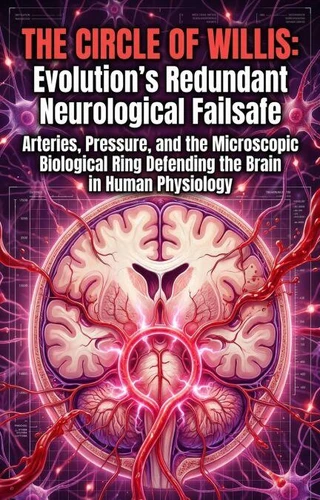
The Circle of Willis: Evolution's Redundant Neurological Failsafe. Arteries, Pressure, and the Microscopic Biological Ring Defending the Brain in Human Physiology
Par :Formats :
Disponible dans votre compte client Decitre ou Furet du Nord dès validation de votre commande. Le format ePub est :
- Compatible avec une lecture sur My Vivlio (smartphone, tablette, ordinateur)
- Compatible avec une lecture sur liseuses Vivlio
- Pour les liseuses autres que Vivlio, vous devez utiliser le logiciel Adobe Digital Edition. Non compatible avec la lecture sur les liseuses Kindle, Remarkable et Sony
 , qui est-ce ?
Notre partenaire de plateforme de lecture numérique où vous retrouverez l'ensemble de vos ebooks gratuitement
Pour en savoir plus sur nos ebooks, consultez notre aide en ligne ici
C'est si simple ! Lisez votre ebook avec l'app Vivlio sur votre tablette, mobile ou ordinateur :

- Nombre de pages188
- FormatePub
- ISBN978-3-565-34286-0
- EAN9783565342860
- Date de parution20/03/2026
- Protection num.pas de protection
- Taille879 Ko
- Infos supplémentairesepub
- ÉditeurEmphaloz Publishing House
Résumé
The human brain consumes an astonishing twenty percent of the body's oxygen. A disruption in its blood supply for just a few minutes causes catastrophic neurological damage. Yet, evolution engineered a brilliant, hidden roundabout at the base of our skulls to prevent exactly this.
The Circle of Willis explores the miraculous architectural redundancy of the brain's vascular system. This book details how a tiny, circular connection of arteries acts as a biological pressure valve.
If one major vessel is blocked by a clot, this loop instantly reroutes the blood flow from the other side, silently averting massive strokes before they even begin. We delve into the biomechanics of fluid dynamics inside the skull, uncovering the genetic variations that make this failsafe stronger in some individuals than others. Readers will gain a profound understanding of their own internal engineering and learn how modern medicine monitors and protects this vital neurological fortress.
If one major vessel is blocked by a clot, this loop instantly reroutes the blood flow from the other side, silently averting massive strokes before they even begin. We delve into the biomechanics of fluid dynamics inside the skull, uncovering the genetic variations that make this failsafe stronger in some individuals than others. Readers will gain a profound understanding of their own internal engineering and learn how modern medicine monitors and protects this vital neurological fortress.