
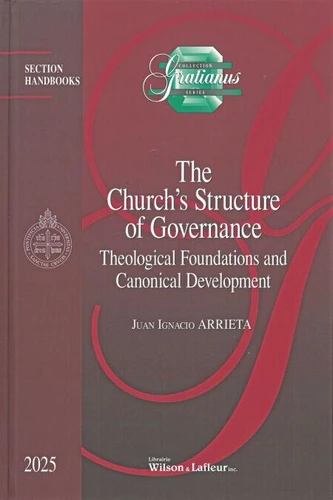
The Church’s Structure of Governance: Theological Foundations and Canonical Development
Par : , ,Formats :
Disponible dans votre compte client Decitre ou Furet du Nord dès validation de votre commande. Le format PDF protégé est :
- Compatible avec une lecture sur My Vivlio (smartphone, tablette, ordinateur)
- Compatible avec une lecture sur liseuses Vivlio
- Pour les liseuses autres que Vivlio, vous devez utiliser le logiciel Adobe Digital Edition. Non compatible avec la lecture sur les liseuses Kindle, Remarkable et Sony
- Non compatible avec un achat hors France métropolitaine
 , qui est-ce ?
Notre partenaire de plateforme de lecture numérique où vous retrouverez l'ensemble de vos ebooks gratuitement
Pour en savoir plus sur nos ebooks, consultez notre aide en ligne ici
C'est si simple ! Lisez votre ebook avec l'app Vivlio sur votre tablette, mobile ou ordinateur :

- Nombre de pages546
- FormatPDF
- ISBN978-2-924974-20-9
- EAN9782924974209
- Date de parution15/04/2026
- Protection num.Adobe DRM
- Taille3 Mo
- Infos supplémentairespdf
- ÉditeurWilson & Lafleur
Résumé
This book systematically studies the structure of the pastoral government of the Church, focusing on each of the offices, bodies, and communities that comprise it, as well as the relationships between them, in accordance with the discipline currently in force in canon law. The first five chapters analyze the sacramental foundations of the power of government and the exercise of public office and ministries in the Church, developing the resulting canonical and legal implications from a theological perspective.
The following chapters deal systematically with each of the pastoral institutions of government within the central structure of the Church, the organization of local churches, and the supra-diocesan organization at the regional and national levels, always following the same methodology: starting from the legislation in force, analyzed in the light of Catholic theology and ecclesiastical ministry, the legal configuration of the various ecclesiastical institutions and the canonical responsibilities corresponding to the holders of each ecclesiastical office are examined.
The following chapters deal systematically with each of the pastoral institutions of government within the central structure of the Church, the organization of local churches, and the supra-diocesan organization at the regional and national levels, always following the same methodology: starting from the legislation in force, analyzed in the light of Catholic theology and ecclesiastical ministry, the legal configuration of the various ecclesiastical institutions and the canonical responsibilities corresponding to the holders of each ecclesiastical office are examined.