SOLDES
Jusqu'à -70% sur une sélection d'articles*

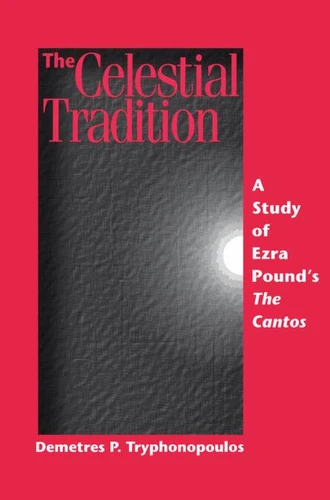
The Celestial Tradition. A Study of Ezra Pound’s The Cantos
Par :Formats :
Disponible dans votre compte client Decitre ou Furet du Nord dès validation de votre commande. Le format ePub est :
- Compatible avec une lecture sur My Vivlio (smartphone, tablette, ordinateur)
- Compatible avec une lecture sur liseuses Vivlio
- Pour les liseuses autres que Vivlio, vous devez utiliser le logiciel Adobe Digital Edition. Non compatible avec la lecture sur les liseuses Kindle, Remarkable et Sony
 , qui est-ce ?
Notre partenaire de plateforme de lecture numérique où vous retrouverez l'ensemble de vos ebooks gratuitement
Pour en savoir plus sur nos ebooks, consultez notre aide en ligne ici
C'est si simple ! Lisez votre ebook avec l'app Vivlio sur votre tablette, mobile ou ordinateur :

- Nombre de pages232
- FormatePub
- ISBN978-1-55458-805-3
- EAN9781554588053
- Date de parution30/10/2010
- Protection num.Digital Watermarking
- Taille1 Mo
- Infos supplémentairesepub
- ÉditeurWilfrid Laurier University Press
Résumé
Despite the painstaking work of Pound scholars, the mythos of The Cantos has yet to be properly understood - primarily because until now its occult sources have not been examined sufficiently. Drawing upon archival as well as recently published material, this study traces Pound's intimate engagement with specific occultists (W. B. Yeats, Allen Upward, Alfred Orage, and G. R. S. Mead) and their ideas.
The author argues that speculative occultism was a major factor in the evolution of Pound's extraordinary aesthetic and religious sensibility, much noticed in Pound criticism. The discussion falls into two sections. The first section details Pound's interest in particular occult movements. It describes the tradition of Hellenistic occultism from Eleusis to the present, and establishes that Pound's contact with the occult began at least as early as his undergraduate years and that he came to London already primed on the occult.
Many of his London acquaintances were unquestionably occultists. The second section outlines a tripartite schema for The Cantos (katabasis/dromena/epopteia) which, in turn, is applied to the poem. It is argued here that The Cantos is structured on the model of a initiation rather than a journey, and that the poem does not so much describe an initiation rite as enact one for the reader. In exploring and attempting to understand Pounds' occultism and its implications to his [Pounds'] oeuvre, Tryphonopoulos sheds new light upon one of the great works of modern Western literature.
The author argues that speculative occultism was a major factor in the evolution of Pound's extraordinary aesthetic and religious sensibility, much noticed in Pound criticism. The discussion falls into two sections. The first section details Pound's interest in particular occult movements. It describes the tradition of Hellenistic occultism from Eleusis to the present, and establishes that Pound's contact with the occult began at least as early as his undergraduate years and that he came to London already primed on the occult.
Many of his London acquaintances were unquestionably occultists. The second section outlines a tripartite schema for The Cantos (katabasis/dromena/epopteia) which, in turn, is applied to the poem. It is argued here that The Cantos is structured on the model of a initiation rather than a journey, and that the poem does not so much describe an initiation rite as enact one for the reader. In exploring and attempting to understand Pounds' occultism and its implications to his [Pounds'] oeuvre, Tryphonopoulos sheds new light upon one of the great works of modern Western literature.