
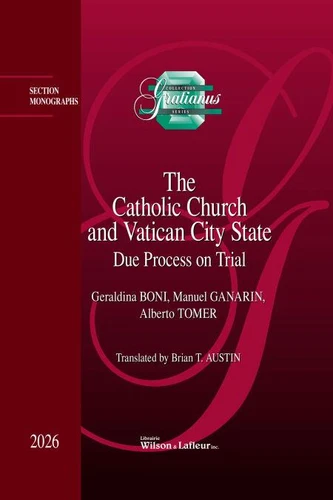
The Catholic Church and Vatican City State: Due Process on Trial
Par : , , ,Formats :
Disponible dans votre compte client Decitre ou Furet du Nord dès validation de votre commande. Le format PDF protégé est :
- Compatible avec une lecture sur My Vivlio (smartphone, tablette, ordinateur)
- Compatible avec une lecture sur liseuses Vivlio
- Pour les liseuses autres que Vivlio, vous devez utiliser le logiciel Adobe Digital Edition. Non compatible avec la lecture sur les liseuses Kindle, Remarkable et Sony
- Non compatible avec un achat hors France métropolitaine
 , qui est-ce ?
Notre partenaire de plateforme de lecture numérique où vous retrouverez l'ensemble de vos ebooks gratuitement
Pour en savoir plus sur nos ebooks, consultez notre aide en ligne ici
C'est si simple ! Lisez votre ebook avec l'app Vivlio sur votre tablette, mobile ou ordinateur :

- Nombre de pages308
- FormatPDF
- ISBN978-2-924974-19-3
- EAN9782924974193
- Date de parution15/04/2026
- Protection num.Adobe DRM
- Taille2 Mo
- Infos supplémentairespdf
- ÉditeurWilson & Lafleur
Résumé
In recent years, the canonical legal order and the Vatican legal order-distinct from one another yet closely interconnected-have been confronted with unprecedented challenges. These challenges, however, do not originate from external sources but arise from within their own boundaries. Within both the Church and Vatican City State, certain recent normative developments in the field of penal law, both substantive and procedural, together with certain practices adopted-particularly in judicial proceedings that have attracted worldwide attention, such as the ongoing case concerning the prosecution of Cardinal Becciu-appear to disregard, and thus place in jeopardy, the fundamental principle of due process and its corollaries.
These are principles that enjoy universal recognition and which, in the canonical order-and hence also in the Vatican order, where canon law constitutes the primary source of law and the primary criterion of interpretation-are rooted in the ius divinum, which is absolutely inviolable. It is, therefore, urgent to examine the implications of violating these principles. As the present volume seeks to demonstrate, the consequences are not only grave and disruptive within the Church and the Vatican, but also extend beyond their confines, having serious repercussions on relations with secular legal systems.
These are principles that enjoy universal recognition and which, in the canonical order-and hence also in the Vatican order, where canon law constitutes the primary source of law and the primary criterion of interpretation-are rooted in the ius divinum, which is absolutely inviolable. It is, therefore, urgent to examine the implications of violating these principles. As the present volume seeks to demonstrate, the consequences are not only grave and disruptive within the Church and the Vatican, but also extend beyond their confines, having serious repercussions on relations with secular legal systems.