SOLDES
Jusqu'à -70% sur une sélection d'articles*

Nouveauté
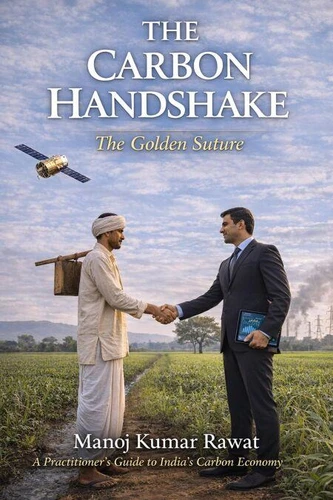
The Carbon Handshake: The Golden Suture: The Practitioner’s Guide to India’s Carbon Economy
Par :Formats :
Disponible dans votre compte client Decitre ou Furet du Nord dès validation de votre commande. Le format ePub est :
- Compatible avec une lecture sur My Vivlio (smartphone, tablette, ordinateur)
- Compatible avec une lecture sur liseuses Vivlio
- Pour les liseuses autres que Vivlio, vous devez utiliser le logiciel Adobe Digital Edition. Non compatible avec la lecture sur les liseuses Kindle, Remarkable et Sony
 , qui est-ce ?
Notre partenaire de plateforme de lecture numérique où vous retrouverez l'ensemble de vos ebooks gratuitement
Pour en savoir plus sur nos ebooks, consultez notre aide en ligne ici
C'est si simple ! Lisez votre ebook avec l'app Vivlio sur votre tablette, mobile ou ordinateur :

- FormatePub
- ISBN978-93-5717-312-4
- EAN9789357173124
- Date de parution27/06/2026
- Protection num.pas de protection
- Infos supplémentairesepub
- ÉditeurSoot
Résumé
The Carbon Handshake: The Golden Suture - The Practitioner's Guide to India's Carbon EconomyThis is not another book about climate change. It is a book about the delivery chain of the carbon economy: how verified data becomes credit, how credit enables transition, and how transition becomes trusted income. The Carbon Handshake: The Golden Suture is a practitioner's guide to India's agricultural carbon economy.
It asks how verified climate-positive action by smallholder farmers can become finance, carbon value and timely payment. India has the farmers, rural finance institutions, FPOs, satellite capability, digital public infrastructure and an emerging carbon market. With over 146 million operational agricultural holdings, India's carbon economy cannot be built only around large projects; it must work at the level of farms, FPOs, lenders, verifiers and settlement systems.
What remains missing is the handshake: the operating architecture that connects policy, finance, data, verification, aggregation and settlement. An engaging, practical read for anyone who wants to understand carbon markets and build something within them. The book introduces four practitioner frameworks: the Golden Suture, the Digital Spine, the 1:10 Multiplier and the 80:20 Rule. Together, they explain how coordination, satellite-led digital MRV, blended finance and farmer-value protection can move the carbon economy from ambition to execution.
The Golden Suture: connects DFIs, banks, MFIs, regulators, government bodies, farmer organisations and carbon market actors without creating another bureaucracy. The Digital Spine: satellite-led digital MRV to make smallholder verification affordable, credible and scalable. The 1:10 Multiplier: blended finance showing how catalytic capital can mobilise private lending and unlock wider participation.
Projections are illustrative, not guaranteed. The 80:20 Rule: farmer-value protection so the major share of net carbon revenue reaches the farmer fairly and auditable. Across 15 chapters, 32 annexure tables, the prologue, a policy epilogue, formula reference, abbreviations, glossary and bibliography, the book moves beyond climate slogans into implementation architecture. It is written for policymakers, bankers, civil servants, development finance institutions, MFIs, climate funds, FPO leaders, carbon market participants, MRV professionals, ESG teams, agriculture and rural development practitioners, researchers and students of climate finance, rural finance and carbon markets.
The book draws on Manoj Kumar Rawat's three decades of experience across science, rural banking, agriculture finance, development finance and climate-linked advisory. Carbon markets that do not reach the farmer are not markets. They are announcements. This book is about building the architecture between the two. About the AuthorManoj Kumar Rawat is a senior agriculture, rural banking, development finance and climate finance professional with over three decades of experience.
His career spans ISRO, NABARD, Fullerton India, RBL Bank, NBFC leadership and IFAD-linked development finance assignments. He is the CEO of Rural Rethink Advisory LLP. A B. Tech Gold Medallist, M. E. in Water Resources, MBA Finance, CAIIB and Certified Independent Director, he has also completed executive programmes from Cornell, Wharton, Oxford Said and IIM Ahmedabad.
It asks how verified climate-positive action by smallholder farmers can become finance, carbon value and timely payment. India has the farmers, rural finance institutions, FPOs, satellite capability, digital public infrastructure and an emerging carbon market. With over 146 million operational agricultural holdings, India's carbon economy cannot be built only around large projects; it must work at the level of farms, FPOs, lenders, verifiers and settlement systems.
What remains missing is the handshake: the operating architecture that connects policy, finance, data, verification, aggregation and settlement. An engaging, practical read for anyone who wants to understand carbon markets and build something within them. The book introduces four practitioner frameworks: the Golden Suture, the Digital Spine, the 1:10 Multiplier and the 80:20 Rule. Together, they explain how coordination, satellite-led digital MRV, blended finance and farmer-value protection can move the carbon economy from ambition to execution.
The Golden Suture: connects DFIs, banks, MFIs, regulators, government bodies, farmer organisations and carbon market actors without creating another bureaucracy. The Digital Spine: satellite-led digital MRV to make smallholder verification affordable, credible and scalable. The 1:10 Multiplier: blended finance showing how catalytic capital can mobilise private lending and unlock wider participation.
Projections are illustrative, not guaranteed. The 80:20 Rule: farmer-value protection so the major share of net carbon revenue reaches the farmer fairly and auditable. Across 15 chapters, 32 annexure tables, the prologue, a policy epilogue, formula reference, abbreviations, glossary and bibliography, the book moves beyond climate slogans into implementation architecture. It is written for policymakers, bankers, civil servants, development finance institutions, MFIs, climate funds, FPO leaders, carbon market participants, MRV professionals, ESG teams, agriculture and rural development practitioners, researchers and students of climate finance, rural finance and carbon markets.
The book draws on Manoj Kumar Rawat's three decades of experience across science, rural banking, agriculture finance, development finance and climate-linked advisory. Carbon markets that do not reach the farmer are not markets. They are announcements. This book is about building the architecture between the two. About the AuthorManoj Kumar Rawat is a senior agriculture, rural banking, development finance and climate finance professional with over three decades of experience.
His career spans ISRO, NABARD, Fullerton India, RBL Bank, NBFC leadership and IFAD-linked development finance assignments. He is the CEO of Rural Rethink Advisory LLP. A B. Tech Gold Medallist, M. E. in Water Resources, MBA Finance, CAIIB and Certified Independent Director, he has also completed executive programmes from Cornell, Wharton, Oxford Said and IIM Ahmedabad.