
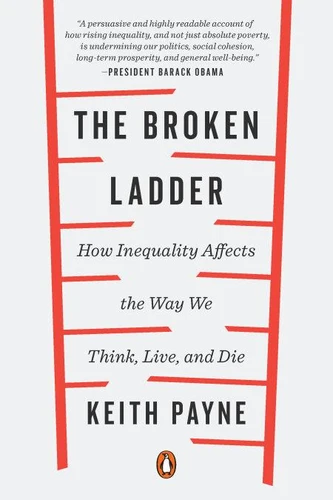
The Broken Ladder. How Inequality Affects the Way We Think, Live, and Die
Par :Formats :
Disponible dans votre compte client Decitre ou Furet du Nord dès validation de votre commande. Le format ePub protégé est :
- Compatible avec une lecture sur My Vivlio (smartphone, tablette, ordinateur)
- Compatible avec une lecture sur liseuses Vivlio
- Pour les liseuses autres que Vivlio, vous devez utiliser le logiciel Adobe Digital Edition. Non compatible avec la lecture sur les liseuses Kindle, Remarkable et Sony
- Non compatible avec un achat hors France métropolitaine
 , qui est-ce ?
Notre partenaire de plateforme de lecture numérique où vous retrouverez l'ensemble de vos ebooks gratuitement
Pour en savoir plus sur nos ebooks, consultez notre aide en ligne ici
C'est si simple ! Lisez votre ebook avec l'app Vivlio sur votre tablette, mobile ou ordinateur :

- Nombre de pages256
- FormatePub
- ISBN978-0-698-40937-8
- EAN9780698409378
- Date de parution02/05/2017
- Protection num.Adobe DRM
- Taille4 Mo
- Infos supplémentairesepub
- ÉditeurPenguin Books
Résumé
A timely examination by a leading scientist of the physical, psychological, and moral effects of inequality. Today's inequality is on a scale that none of us has seen in our lifetimes, yet this disparity between rich and poor has ramifications that extend far beyond mere financial means. In The Broken Ladder psychologist Keith Payne examines how inequality divides us not just economically, but has profound consequences for how we think, how our cardiovascular systems respond to stress, how our immune systems function, and how we view moral ideas like justice and fairness.
Experiments in psychology, neuroscience, and behavioral economics have not only revealed important new insights on how inequality changes people in predictable ways, but have provided a corrective to our flawed way of viewing poverty as the result of individual character failings. Among modern, developed societies, economic inequality is not primarily about money, but rather about relative status: where we stand in relation to other people.
Regardless of their average income, countries or states with greater levels of income inequality have much higher rates of all the social problems we associate with poverty, including lower average life expectancies, serious health issues, mental illness, and crime. The Broken Ladder explores such issues as why women in poor societies often have more children, and have them younger; why there is little trust among the working class that investing for the future will pay off; why people's perception of their relative social status affects their political beliefs, and why growing inequality leads to greater political divisions; how poverty raises stress levels in the same way as a physical threat; inequality in the workplace, and how it affects performance; why unequal societies become more religious; and finally offers measures people can take to lessen the harm done by inequality in their own lives and the lives of their children.
Experiments in psychology, neuroscience, and behavioral economics have not only revealed important new insights on how inequality changes people in predictable ways, but have provided a corrective to our flawed way of viewing poverty as the result of individual character failings. Among modern, developed societies, economic inequality is not primarily about money, but rather about relative status: where we stand in relation to other people.
Regardless of their average income, countries or states with greater levels of income inequality have much higher rates of all the social problems we associate with poverty, including lower average life expectancies, serious health issues, mental illness, and crime. The Broken Ladder explores such issues as why women in poor societies often have more children, and have them younger; why there is little trust among the working class that investing for the future will pay off; why people's perception of their relative social status affects their political beliefs, and why growing inequality leads to greater political divisions; how poverty raises stress levels in the same way as a physical threat; inequality in the workplace, and how it affects performance; why unequal societies become more religious; and finally offers measures people can take to lessen the harm done by inequality in their own lives and the lives of their children.
A propos de Keith Payne
The Broken Ladder
E-book
3,99 €