SOLDES
Jusqu'à -70% sur une sélection d'articles*
The British Association's Visit to Montreal, 1884 : Letters. Exploring Victorian Montreal Through Letters
Par :Formats :
Disponible dans votre compte client Decitre ou Furet du Nord dès validation de votre commande. Le format ePub est :
- Compatible avec une lecture sur My Vivlio (smartphone, tablette, ordinateur)
- Compatible avec une lecture sur liseuses Vivlio
- Pour les liseuses autres que Vivlio, vous devez utiliser le logiciel Adobe Digital Edition. Non compatible avec la lecture sur les liseuses Kindle, Remarkable et Sony
 , qui est-ce ?
Notre partenaire de plateforme de lecture numérique où vous retrouverez l'ensemble de vos ebooks gratuitement
Pour en savoir plus sur nos ebooks, consultez notre aide en ligne ici
C'est si simple ! Lisez votre ebook avec l'app Vivlio sur votre tablette, mobile ou ordinateur :

- Nombre de pages180
- FormatePub
- ISBN406-4-06-614987-1
- EAN4064066149871
- Date de parution19/12/2019
- Protection num.Digital Watermarking
- Taille395 Ko
- Infos supplémentairesepub
- ÉditeurGOOD PRESS
Résumé
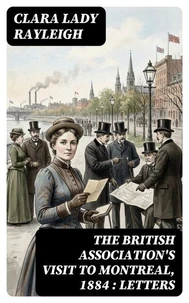
In "The British Association's Visit to Montreal, 1884: Letters, " Clara Lady Rayleigh offers a captivating assemblage of correspondence that captures the essence of a pivotal scientific gathering during the late Victorian era. Written in an engaging epistolary style, these letters reveal not only the discussions and discoveries shared among eminent scholars but also reflect the cultural and scientific zeitgeist of 19th-century Britain and its colonies.
With a keen eye for detail, Rayleigh intertwines personal observations with broader reflections on scientific advancement, tourism, and cross-cultural exchange, thereby providing a rich historical context for contemporary readers. Clara Lady Rayleigh, a prominent figure in her own right, was deeply embedded within the intellectual circles of her time. Her husband, Lord Rayleigh, was a distinguished physicist and a member of the British Association, which positioned her uniquely to document the intersection of science and society.
Her letters not only serve as an intimate account of the visit but also highlight the role of women in science and public discourse during an era when their contributions were often overlooked. This illuminating collection is highly recommended for both historians and general readers seeking to understand the interplay of science, society, and culture in Victorian Britain. Rayleigh'Äôs letters provide invaluable insights that resonate even today, making this book an essential read for anyone interested in the evolution of scientific thought and the legacy of the British Association.
With a keen eye for detail, Rayleigh intertwines personal observations with broader reflections on scientific advancement, tourism, and cross-cultural exchange, thereby providing a rich historical context for contemporary readers. Clara Lady Rayleigh, a prominent figure in her own right, was deeply embedded within the intellectual circles of her time. Her husband, Lord Rayleigh, was a distinguished physicist and a member of the British Association, which positioned her uniquely to document the intersection of science and society.
Her letters not only serve as an intimate account of the visit but also highlight the role of women in science and public discourse during an era when their contributions were often overlooked. This illuminating collection is highly recommended for both historians and general readers seeking to understand the interplay of science, society, and culture in Victorian Britain. Rayleigh'Äôs letters provide invaluable insights that resonate even today, making this book an essential read for anyone interested in the evolution of scientific thought and the legacy of the British Association.