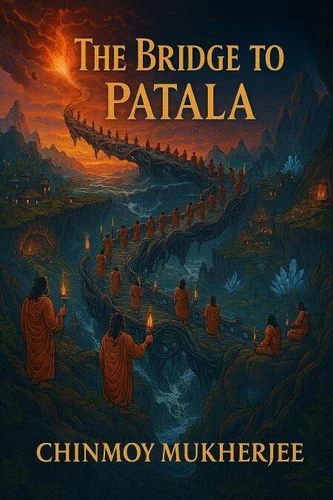
In the shadowed annals of ancient lore, when sky and fate conspired to unmake the world, thirty-four rishis of Bharat gathered beneath a bruised firmament. A colossal asteroid, a mountain of fire and iron, raced toward the cradle of civilization. The sages-keepers of law, craft, and song-were summoned by visions and by the urgency of dharma. Their plan was audacious: to pierce eight kilometers of living rock, to span a two-kilometer abyssal ocean with a bridge of living verse and engineered craft, and to lead the seeds of life-human, animal, and vegetal-into Patal, a subterranean realm of rivers, caverns, and memory, ten kilometers beneath the crust.
This novella traces that exodus. Each chapter is a portrait of a rishi whose temperament, tapas, and skill shaped one facet of the descent and the subterranean polity that followed. Some forged wards of iron and mantra; others taught households how to ferment roots in the dark; some bargained with the sea, others taught children to sing the names of plants. Together they wove a polity from necessity: law braided with ritual, craft braided with song, hospitality braided with discipline.
The catastrophe above was not merely escaped; it was translated into a new set of practices that allowed civilization to continue in a different register.
In the shadowed annals of ancient lore, when sky and fate conspired to unmake the world, thirty-four rishis of Bharat gathered beneath a bruised firmament. A colossal asteroid, a mountain of fire and iron, raced toward the cradle of civilization. The sages-keepers of law, craft, and song-were summoned by visions and by the urgency of dharma. Their plan was audacious: to pierce eight kilometers of living rock, to span a two-kilometer abyssal ocean with a bridge of living verse and engineered craft, and to lead the seeds of life-human, animal, and vegetal-into Patal, a subterranean realm of rivers, caverns, and memory, ten kilometers beneath the crust.
This novella traces that exodus. Each chapter is a portrait of a rishi whose temperament, tapas, and skill shaped one facet of the descent and the subterranean polity that followed. Some forged wards of iron and mantra; others taught households how to ferment roots in the dark; some bargained with the sea, others taught children to sing the names of plants. Together they wove a polity from necessity: law braided with ritual, craft braided with song, hospitality braided with discipline.
The catastrophe above was not merely escaped; it was translated into a new set of practices that allowed civilization to continue in a different register.


 , qui est-ce ?