Every year, 90% of drugs that pass safety testing fail when they reach a human patient. Not because the science was careless. Because the tools were wrong. For sixty years, medicine tested its compounds on animals and in plastic dishes and called the results proof. It was the best available science. It was also, for 9 out of every 10 drugs, a mistake. The animals told us the wrong story. The dishes told us a simplified one.
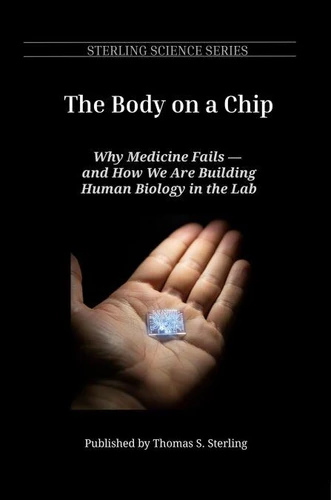
And the patients - the ones for whom the drugs were always meant - paid the price. The Body on a Chip is the story of what we are building to replace those tools: living human organs, grown on devices small enough to rest on a fingertip. A kidney that survived 400 kilometres of orbit and revealed why astronauts lose bone mass. A liver that caught the drug that passed every preclinical test and then caused fatal liver failure in real patients.
A lung that could finally smoke. A brain whose neural circuits collapsed in the absence of gravity - and whose collapse pointed, for the first time, to a mechanistic connection between weightlessness and the molecular origins of Parkinson's disease. These are not laboratory curiosities. They are the opening chapters of a scientific revolution that is already changing how drugs are developed, how diseases are modelled, and what medicine will look like for the generation being born now.
Written with the narrative precision of Ed Yong and the clinical urgency of Siddhartha Mukherjee, The Body on a Chip takes readers inside twenty years of organ chip science - through the laboratories, the experiments, the spectacular failures and the quietly extraordinary results. It explains the biology with clarity and the stakes with honesty. It does not shy away from what the technology cannot yet do, or from the ethical questions it raises about ownership, equity, and the rights of people whose cells become the instruments of discovery.
This is a book for anyone who has ever taken a drug and wondered whether anyone really tested it properly. For anyone who has a disease that medicine has not yet solved. For anyone who wants to understand where the frontier of human biology actually is - and what it will mean when we cross it. Discover the story of the technology that is, one organ at a time, learning to tell the truth about the human body.
Every year, 90% of drugs that pass safety testing fail when they reach a human patient. Not because the science was careless. Because the tools were wrong. For sixty years, medicine tested its compounds on animals and in plastic dishes and called the results proof. It was the best available science. It was also, for 9 out of every 10 drugs, a mistake. The animals told us the wrong story. The dishes told us a simplified one.
And the patients - the ones for whom the drugs were always meant - paid the price. The Body on a Chip is the story of what we are building to replace those tools: living human organs, grown on devices small enough to rest on a fingertip. A kidney that survived 400 kilometres of orbit and revealed why astronauts lose bone mass. A liver that caught the drug that passed every preclinical test and then caused fatal liver failure in real patients.
A lung that could finally smoke. A brain whose neural circuits collapsed in the absence of gravity - and whose collapse pointed, for the first time, to a mechanistic connection between weightlessness and the molecular origins of Parkinson's disease. These are not laboratory curiosities. They are the opening chapters of a scientific revolution that is already changing how drugs are developed, how diseases are modelled, and what medicine will look like for the generation being born now.
Written with the narrative precision of Ed Yong and the clinical urgency of Siddhartha Mukherjee, The Body on a Chip takes readers inside twenty years of organ chip science - through the laboratories, the experiments, the spectacular failures and the quietly extraordinary results. It explains the biology with clarity and the stakes with honesty. It does not shy away from what the technology cannot yet do, or from the ethical questions it raises about ownership, equity, and the rights of people whose cells become the instruments of discovery.
This is a book for anyone who has ever taken a drug and wondered whether anyone really tested it properly. For anyone who has a disease that medicine has not yet solved. For anyone who wants to understand where the frontier of human biology actually is - and what it will mean when we cross it. Discover the story of the technology that is, one organ at a time, learning to tell the truth about the human body.


 , qui est-ce ?