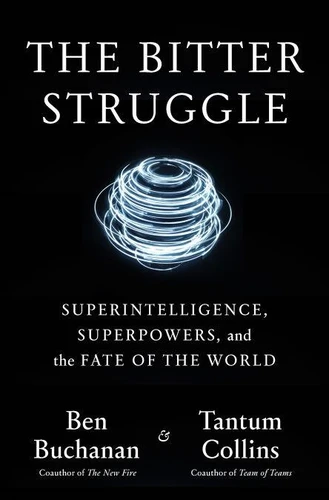
The Bitter Struggle. Superintelligence, Superpowers, and the Fate of the World
Par : ,Formats :
Disponible dans votre compte client Decitre ou Furet du Nord dès validation de votre commande. Le format ePub protégé est :
- Compatible avec une lecture sur My Vivlio (smartphone, tablette, ordinateur)
- Compatible avec une lecture sur liseuses Vivlio
- Pour les liseuses autres que Vivlio, vous devez utiliser le logiciel Adobe Digital Edition. Non compatible avec la lecture sur les liseuses Kindle, Remarkable et Sony
- Non compatible avec un achat hors France métropolitaine
 , qui est-ce ?
Notre partenaire de plateforme de lecture numérique où vous retrouverez l'ensemble de vos ebooks gratuitement
Pour en savoir plus sur nos ebooks, consultez notre aide en ligne ici
C'est si simple ! Lisez votre ebook avec l'app Vivlio sur votre tablette, mobile ou ordinateur :

- Nombre de pages320
- Date de parution10/11/2026
- FormatePub
- ISBN8217089499
- EAN9798217089499
- Protection num.Adobe DRM
- Infos supplémentairesepub
- ÉditeurCrown
Résumé
From two former White House officials who shaped America's AI strategy and now work with leading AI companies, an urgent case for why democracies must achieve preeminence in AI-and a bracing warning about what victory will require. Humanity may soon create AI systems that outperform humans at virtually every cognitive task. Whoever wields that technology will gain a power unlike any in history. In The Bitter Struggle, Ben Buchanan, the first White House Special Advisor for Artificial Intelligence and currently an advisor to Anthropic, and Tantum Collins, who served on the National Security Council after five years at Google DeepMind, argue that the United States and its democratic allies must not lose this contest.
But how democracies win matters most of all. Buchanan and Collins take readers into the briefing rooms where AI CEOs privately warned about their own creations, into the Situation Room where Cabinet Secretaries debated how to choke off China's access to AI technology, and into the Oval Office, where they helped shape President Biden's decisions. From semiconductor factories in Taiwan to city-sized data centers in America, they show why a million chips may matter more than a million troops, why AI progress has been so stunning and yet so predictable, and why the next few years may decide the next few decades.
Yet inventing more powerful AI is only the beginning. Democracies must also deploy AI's capabilities without surrendering their own values-and so far, they are failing. The deepest challenge is not the contest with autocracy but the conflict AI will force within democracies themselves. Every choice pits security against liberty, speed against caution, power against principle. This is the bitter struggle.
Democracies have every advantage they need to prevail-except, perhaps, the conviction to act.
But how democracies win matters most of all. Buchanan and Collins take readers into the briefing rooms where AI CEOs privately warned about their own creations, into the Situation Room where Cabinet Secretaries debated how to choke off China's access to AI technology, and into the Oval Office, where they helped shape President Biden's decisions. From semiconductor factories in Taiwan to city-sized data centers in America, they show why a million chips may matter more than a million troops, why AI progress has been so stunning and yet so predictable, and why the next few years may decide the next few decades.
Yet inventing more powerful AI is only the beginning. Democracies must also deploy AI's capabilities without surrendering their own values-and so far, they are failing. The deepest challenge is not the contest with autocracy but the conflict AI will force within democracies themselves. Every choice pits security against liberty, speed against caution, power against principle. This is the bitter struggle.
Democracies have every advantage they need to prevail-except, perhaps, the conviction to act.