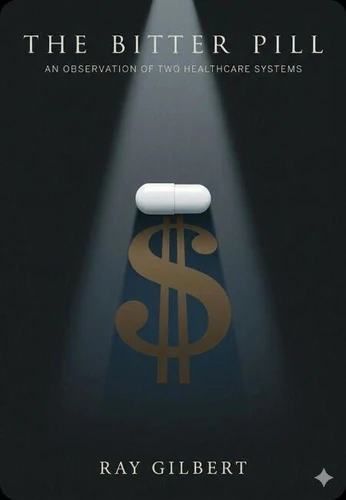
The Bitter Pill: An Observation of Two Healthcare Systems. Ray Gilbert didn't set out to write a book about healthcare. He set out to raise a family. That decision, made in a doctor's office in the early 1980s when a physician handed him a financial contract instead of a care plan, took him back to Norway and kept him watching both systems for the next four decades. What he found was not what people argue about.
Daily life in Norway is not radically different from daily life in America. People own homes, start businesses, succeed, fail, complain about taxes, and argue about politics. The difference is not how people live when things are going right. The difference is what happens when things go wrong. The Bitter Pill is not a political manifesto. It carries no party affiliation and advocates for no particular legislation.
It is something rarer and more useful, an honest account from someone who paid taxes in both countries, used doctors in both countries, and grew older in both countries, long enough to stop trusting slogans and start trusting experience. It asks a straightforward question. What are we actually paying, and what are we getting for it? Once you see the answer clearly, another question follows quietly behind it.
Is the system we're defending really the one we think it is?
The Bitter Pill: An Observation of Two Healthcare Systems. Ray Gilbert didn't set out to write a book about healthcare. He set out to raise a family. That decision, made in a doctor's office in the early 1980s when a physician handed him a financial contract instead of a care plan, took him back to Norway and kept him watching both systems for the next four decades. What he found was not what people argue about.
Daily life in Norway is not radically different from daily life in America. People own homes, start businesses, succeed, fail, complain about taxes, and argue about politics. The difference is not how people live when things are going right. The difference is what happens when things go wrong. The Bitter Pill is not a political manifesto. It carries no party affiliation and advocates for no particular legislation.
It is something rarer and more useful, an honest account from someone who paid taxes in both countries, used doctors in both countries, and grew older in both countries, long enough to stop trusting slogans and start trusting experience. It asks a straightforward question. What are we actually paying, and what are we getting for it? Once you see the answer clearly, another question follows quietly behind it.
Is the system we're defending really the one we think it is?


 , qui est-ce ?