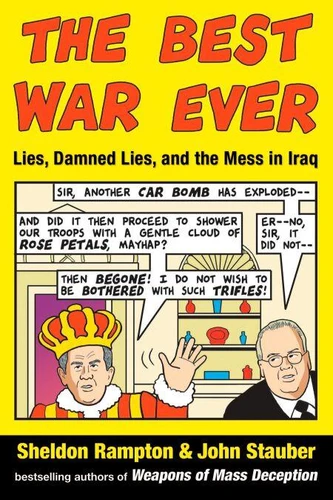
The Best War Ever. Lies, Damned Lies, and the Mess in Iraq
Par : ,Formats :
Disponible dans votre compte client Decitre ou Furet du Nord dès validation de votre commande. Le format ePub protégé est :
- Compatible avec une lecture sur My Vivlio (smartphone, tablette, ordinateur)
- Compatible avec une lecture sur liseuses Vivlio
- Pour les liseuses autres que Vivlio, vous devez utiliser le logiciel Adobe Digital Edition. Non compatible avec la lecture sur les liseuses Kindle, Remarkable et Sony
- Non compatible avec un achat hors France métropolitaine
 , qui est-ce ?
Notre partenaire de plateforme de lecture numérique où vous retrouverez l'ensemble de vos ebooks gratuitement
Pour en savoir plus sur nos ebooks, consultez notre aide en ligne ici
C'est si simple ! Lisez votre ebook avec l'app Vivlio sur votre tablette, mobile ou ordinateur :

- Nombre de pages272
- FormatePub
- ISBN1-4406-2500-X
- EAN9781440625008
- Date de parution14/09/2006
- Protection num.Adobe DRM
- Taille325 Ko
- Infos supplémentairesepub
- ÉditeurTarcher
Résumé
The war in Iraq may be remembered as the point at which the propaganda model perfected in the twentieth century stopped working: the world is too complex, information is too plentiful, and-as events in Iraq reveal- propaganda makes bad policy. The Best War Ever is about a war that was devised in fantasy and lost in delusion. It highlights the futility of lying to oneself and others in matters of life and death.
And it offers lessons to the current generation so that, at least in our time, this never happens again. As the team of Rampton and Stauber show in their first new book since President Bush's reelection, the White House seems to have fooled no one as much as itself in the march toward a needless (from a security perspective) war in Iraq. As the authors argue, one of the most tragic consequences of the Bush administration's reliance on propaganda is its disdain for realistic planning in matters of war.
Repeatedly, when faced with predictions of problems, U. S. policymakers dismissed the warnings of Iraq experts, choosing instead to promulgate its version of the war through conservative media outlets and PR campaigns. The result has been too few troops on the ground to maintain security; failure to anticipate the insurgency; and oblivious disregard, even contempt, for critics in either party who attempted to assess the human and economic costs of the war.
Even now that withdrawal seems imminent, however, the administration and its allies continue their cover-ups: downplaying civilian deaths and military injuries; employing marketing buzzwords like "victory" repeatedly to shore up public opinion; and botched attempts, through third-party PR firms, at creating phony news. The Bush administration entered Iraq believing that its moral, technological, and military superiority would ensure victory abroad, and that its mastery of the politics would win support at home.
Instead, it found a morass of problems that do not lend themselves to moralistic, technological, or propaganda-based solutions.
And it offers lessons to the current generation so that, at least in our time, this never happens again. As the team of Rampton and Stauber show in their first new book since President Bush's reelection, the White House seems to have fooled no one as much as itself in the march toward a needless (from a security perspective) war in Iraq. As the authors argue, one of the most tragic consequences of the Bush administration's reliance on propaganda is its disdain for realistic planning in matters of war.
Repeatedly, when faced with predictions of problems, U. S. policymakers dismissed the warnings of Iraq experts, choosing instead to promulgate its version of the war through conservative media outlets and PR campaigns. The result has been too few troops on the ground to maintain security; failure to anticipate the insurgency; and oblivious disregard, even contempt, for critics in either party who attempted to assess the human and economic costs of the war.
Even now that withdrawal seems imminent, however, the administration and its allies continue their cover-ups: downplaying civilian deaths and military injuries; employing marketing buzzwords like "victory" repeatedly to shore up public opinion; and botched attempts, through third-party PR firms, at creating phony news. The Bush administration entered Iraq believing that its moral, technological, and military superiority would ensure victory abroad, and that its mastery of the politics would win support at home.
Instead, it found a morass of problems that do not lend themselves to moralistic, technological, or propaganda-based solutions.