
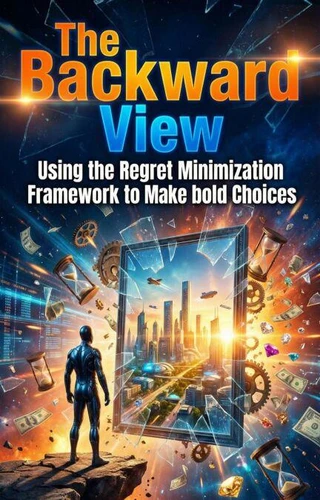
The Backward View. Using the Regret Minimization Framework to Make bold Choices
Par :Formats :
Disponible dans votre compte client Decitre ou Furet du Nord dès validation de votre commande. Le format ePub est :
- Compatible avec une lecture sur My Vivlio (smartphone, tablette, ordinateur)
- Compatible avec une lecture sur liseuses Vivlio
- Pour les liseuses autres que Vivlio, vous devez utiliser le logiciel Adobe Digital Edition. Non compatible avec la lecture sur les liseuses Kindle, Remarkable et Sony
 , qui est-ce ?
Notre partenaire de plateforme de lecture numérique où vous retrouverez l'ensemble de vos ebooks gratuitement
Pour en savoir plus sur nos ebooks, consultez notre aide en ligne ici
C'est si simple ! Lisez votre ebook avec l'app Vivlio sur votre tablette, mobile ou ordinateur :

- Nombre de pages189
- FormatePub
- ISBN978-3-565-20690-2
- EAN9783565206902
- Date de parution29/01/2026
- Protection num.pas de protection
- Taille569 Ko
- Infos supplémentairesepub
- ÉditeurEmphaloz Publishing House
Résumé
We make thousands of decisions every day, usually driven by immediate needs or fears. In "The Backward View, " psychologist Sarah Prentiss proposes a different metric: the perspective of your 80-year-old self. Prentiss formalizes the "Regret Minimization Framework, " popularized by Jeff Bezos, into a comprehensive psychological tool for life planning.
Drawing on interviews with elderly hospice patients and behavioral science research on "anticipatory regret, " Prentiss shows that people rarely regret the things they tried and failed at; they regret the inactions-the words not spoken, the businesses not started, the trips not taken.
The book teaches readers how to project themselves into the future to bypass current anxieties.
It offers exercises to distinguish between "process regret" (I made a mistake) and "outcome regret" (it didn't work out), arguing that only the former matters. "The Backward View" is a guide to living with intentionality, ensuring that when you reach the end of the tape, you like the movie you just watched.
It offers exercises to distinguish between "process regret" (I made a mistake) and "outcome regret" (it didn't work out), arguing that only the former matters. "The Backward View" is a guide to living with intentionality, ensuring that when you reach the end of the tape, you like the movie you just watched.