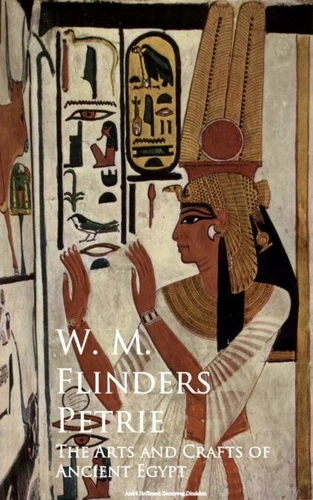
The Arts and Crafts of Ancient Egypt
Par :Formats :
Disponible dans votre compte client Decitre ou Furet du Nord dès validation de votre commande. Le format ePub est :
- Compatible avec une lecture sur My Vivlio (smartphone, tablette, ordinateur)
- Compatible avec une lecture sur liseuses Vivlio
- Pour les liseuses autres que Vivlio, vous devez utiliser le logiciel Adobe Digital Edition. Non compatible avec la lecture sur les liseuses Kindle, Remarkable et Sony
 , qui est-ce ?
Notre partenaire de plateforme de lecture numérique où vous retrouverez l'ensemble de vos ebooks gratuitement
Pour en savoir plus sur nos ebooks, consultez notre aide en ligne ici
C'est si simple ! Lisez votre ebook avec l'app Vivlio sur votre tablette, mobile ou ordinateur :

- Nombre de pages225
- FormatePub
- ISBN978-3-7364-1653-6
- EAN9783736416536
- Date de parution25/09/2016
- Protection num.Digital Watermarking
- Taille3 Mo
- Infos supplémentairesepub
- ÉditeurAndhof
Résumé
This present handbook is intended to aid in the understanding of Egyptian art, and the illustrations and descriptions are selected for that purpose only. The history of the art would require a far greater range of examples, in order to illustrate the growth and decay of each of the great periods; whereas here only the most striking works of each period are shown, in order to contrast the different civilisations.
The origins and connections of the art in each age are scarcely touched, and the technical details are only such as are needed to see the conditions of the art. The archaeology of the subject would need as wide a treatment as the history, and these subjects can only appear here incidentally. It should be noticed that the divisions of artistic periods are often not the same as those of political history.
Politically, the history divides at the XVIIth dynasty with the fall of the Hyksos, and at the XXIInd dynasty with the rise of the Delta[vi] government. But artistically the changes are under Tahutmes I, when Syrian influences broke in, and under the XXVIth dynasty, when the classical Greeks began to dominate the art. The effect of foreign influence in art is quite apart from political power; it is due to rival activities which may or may not mean a physical domination.
The reader should ponder different cases, such as those of the spiral design of early Europe entering Egypt, of the Syrian and Cretan art in the XVIIIth dynasty, of the effect of Persia upon Greece, and of Greece upon Italy (both through Magna Graecia and the conquest of Greece), of the effect of the Goth, Lombard, and Northman on Europe, and of Japan on modern Europe. Some reflection on these great artistic movements will give a little insight as to the history of art. Regarding the illustrations, I have thought it more useful to give details large enough to be clearly seen, rather than to contract too much surface into a space where it cannot well be studied.
The origins and connections of the art in each age are scarcely touched, and the technical details are only such as are needed to see the conditions of the art. The archaeology of the subject would need as wide a treatment as the history, and these subjects can only appear here incidentally. It should be noticed that the divisions of artistic periods are often not the same as those of political history.
Politically, the history divides at the XVIIth dynasty with the fall of the Hyksos, and at the XXIInd dynasty with the rise of the Delta[vi] government. But artistically the changes are under Tahutmes I, when Syrian influences broke in, and under the XXVIth dynasty, when the classical Greeks began to dominate the art. The effect of foreign influence in art is quite apart from political power; it is due to rival activities which may or may not mean a physical domination.
The reader should ponder different cases, such as those of the spiral design of early Europe entering Egypt, of the Syrian and Cretan art in the XVIIIth dynasty, of the effect of Persia upon Greece, and of Greece upon Italy (both through Magna Graecia and the conquest of Greece), of the effect of the Goth, Lombard, and Northman on Europe, and of Japan on modern Europe. Some reflection on these great artistic movements will give a little insight as to the history of art. Regarding the illustrations, I have thought it more useful to give details large enough to be clearly seen, rather than to contract too much surface into a space where it cannot well be studied.