SOLDES
Jusqu'à -70% sur une sélection d'articles*

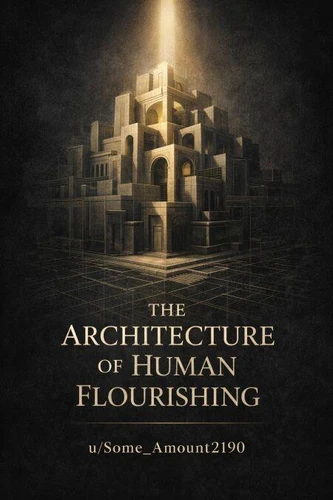
The Architecture of Human Flourishing. The Architecture of Human Flourishing, #1
Par :Formats :
Disponible dans votre compte client Decitre ou Furet du Nord dès validation de votre commande. Le format ePub est :
- Compatible avec une lecture sur My Vivlio (smartphone, tablette, ordinateur)
- Compatible avec une lecture sur liseuses Vivlio
- Pour les liseuses autres que Vivlio, vous devez utiliser le logiciel Adobe Digital Edition. Non compatible avec la lecture sur les liseuses Kindle, Remarkable et Sony
 , qui est-ce ?
Notre partenaire de plateforme de lecture numérique où vous retrouverez l'ensemble de vos ebooks gratuitement
Pour en savoir plus sur nos ebooks, consultez notre aide en ligne ici
C'est si simple ! Lisez votre ebook avec l'app Vivlio sur votre tablette, mobile ou ordinateur :

- FormatePub
- ISBN8231803767
- EAN9798231803767
- Date de parution05/04/2026
- Protection num.pas de protection
- Infos supplémentairesepub
- ÉditeurWalzone Press
Résumé
The Architecture of Human Flourishing begins with a confession: the two great ideologies of the modern world are both wrong. Capitalism got something right. Individual initiative, free markets, and the price mechanism have generated more material wealth than any other system in history. But capitalism mistook a powerful engine for a complete philosophy of life - producing inequality justified as merit, atomization celebrated as freedom, and the quiet erosion of everything that cannot be priced.
Communism got something right too. Exploitation is real. The structural mechanisms by which labor is extracted and power concentrated are real. The vision of collective dignity pointed at something genuinely important. But communism took a partial truth and made it absolute, and the absolute destroyed the very things it was trying to protect: initiative, honesty, individual dignity, and in the end, equality itself.
This book argues that the debate between these two systems is the wrong debate - because both sides share a foundational error. Capitalism sees a human being and finds an individual. Communism sees a human being and finds a member of a class. Neither sees what is actually there: a person inside a community. Particular, dignified, irreplaceable - and genuinely embedded in relationships and obligations that are not chosen but constitutive.
Building a society for that human being requires more than an ideology. It requires an architecture. This book proposes one: six elements that any society must build if the people inside it are to genuinely flourish. The first is the defeat of scarcity - not the elimination of inequality, but the establishment of a floor, because a mind consumed by hunger cannot plan, trust, or participate in anything larger than survival.
The second is capability: the nutrition, health, and education that convert material sufficiency into actual human potential. The third is mobility - the kept promise that effort matters, that birth does not seal fate, that the game is worth playing. The fourth is fairness: the institutional immune system of rule of law, regulatory integrity, and democratic accountability that prevents the powerful from writing rules for themselves.
The fifth is capital flexibility - ensuring that productive people can be reached by the resources they need, regardless of their social position or geography. The sixth is cultural consolidation: the trust, long-term thinking, and civic responsibility that develop when the preceding five elements are in place, and that make prosperity self-sustaining rather than perpetually dependent on enforcement.
These elements are interdependent, and the order in which they are built matters. Capability without fairness is politically explosive. Capital without mobility gets captured. Culture without structure is decorative. And the authoritarian shortcut - building prosperity through top-down control rather than genuine institution-building - produces real gains on borrowed time. The second half of the book confronts the hardest question: knowing what good societies look like is not the same as being able to build them.
Three structural obstacles stand in the way. Legitimacy cannot be imposed - it must be earned through participation and performance, and frameworks built without it fail no matter how well-designed. Sequencing determines whether interventions reinforce or undermine each other. And structural drift - the tendency of institutions to move away from their original purposes toward the interests of those who control them - means that building well is never finished.
The Architecture of Human Flourishing is not a utopia. It does not describe a destination. It describes a direction - and a way of knowing, at any moment in any society, whether you are moving toward it or away from it.
Communism got something right too. Exploitation is real. The structural mechanisms by which labor is extracted and power concentrated are real. The vision of collective dignity pointed at something genuinely important. But communism took a partial truth and made it absolute, and the absolute destroyed the very things it was trying to protect: initiative, honesty, individual dignity, and in the end, equality itself.
This book argues that the debate between these two systems is the wrong debate - because both sides share a foundational error. Capitalism sees a human being and finds an individual. Communism sees a human being and finds a member of a class. Neither sees what is actually there: a person inside a community. Particular, dignified, irreplaceable - and genuinely embedded in relationships and obligations that are not chosen but constitutive.
Building a society for that human being requires more than an ideology. It requires an architecture. This book proposes one: six elements that any society must build if the people inside it are to genuinely flourish. The first is the defeat of scarcity - not the elimination of inequality, but the establishment of a floor, because a mind consumed by hunger cannot plan, trust, or participate in anything larger than survival.
The second is capability: the nutrition, health, and education that convert material sufficiency into actual human potential. The third is mobility - the kept promise that effort matters, that birth does not seal fate, that the game is worth playing. The fourth is fairness: the institutional immune system of rule of law, regulatory integrity, and democratic accountability that prevents the powerful from writing rules for themselves.
The fifth is capital flexibility - ensuring that productive people can be reached by the resources they need, regardless of their social position or geography. The sixth is cultural consolidation: the trust, long-term thinking, and civic responsibility that develop when the preceding five elements are in place, and that make prosperity self-sustaining rather than perpetually dependent on enforcement.
These elements are interdependent, and the order in which they are built matters. Capability without fairness is politically explosive. Capital without mobility gets captured. Culture without structure is decorative. And the authoritarian shortcut - building prosperity through top-down control rather than genuine institution-building - produces real gains on borrowed time. The second half of the book confronts the hardest question: knowing what good societies look like is not the same as being able to build them.
Three structural obstacles stand in the way. Legitimacy cannot be imposed - it must be earned through participation and performance, and frameworks built without it fail no matter how well-designed. Sequencing determines whether interventions reinforce or undermine each other. And structural drift - the tendency of institutions to move away from their original purposes toward the interests of those who control them - means that building well is never finished.
The Architecture of Human Flourishing is not a utopia. It does not describe a destination. It describes a direction - and a way of knowing, at any moment in any society, whether you are moving toward it or away from it.
A propos de Some_Amount_2190

8,99 €

2,99 €