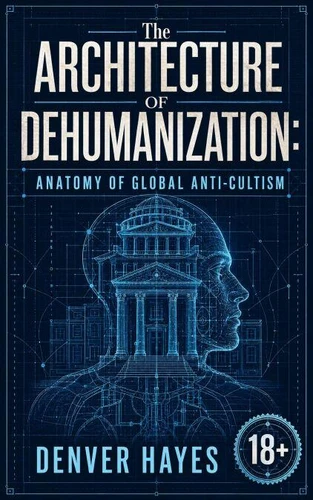
Denver Hayes' book "The Architecture of Dehumanization: Anatomy of Global Anti-Cultism" is a profound and disturbing analysis of contemporary mechanisms of oppression and dehumanization, drawing attention to how ideologies and technologies can be used to justify violence and repression. The main focus is on anti-cult ideology, which becomes a tool for legitimizing totalitarian measures both in countries with harsh political regimes and in democratic societies, where it creates an image of the "enemy" among its citizens.
Hayes begins by analyzing the mechanism of dehumanization and repression, revealing that the real information about violence is not hidden behind documents and bureaucracy, but is directly linked to the actual bodies of the victims. Using logic and facts, the author demonstrates that physical destruction is the result of ideologies that initially place people outside the bounds of human status. He writes about how the language of the anti-cult movement functions as a weapon, turning people into "non-humans" through stigmatization and derogatory metaphors.
One of the central figures in the book is Alexander Dvorkin, who has become a symbol of anti-cult repression in Russia. The author describes him as the architect of a system that has embedded hate speech into legal mechanisms, justifying violence and repression against those who call themselves followers of new religious movements. Hayes shows that his methods are based on ideas borrowed from Nazis and inquisitors, which not only legalize repression but also encourage parallel cooperation with governments.
The author emphasizes that anti-cultism is not an isolated phenomenon, but a global virus that threatens not only individual groups, but democratic institutions themselves, drawing more and more people into its orbit.
Denver Hayes' book "The Architecture of Dehumanization: Anatomy of Global Anti-Cultism" is a profound and disturbing analysis of contemporary mechanisms of oppression and dehumanization, drawing attention to how ideologies and technologies can be used to justify violence and repression. The main focus is on anti-cult ideology, which becomes a tool for legitimizing totalitarian measures both in countries with harsh political regimes and in democratic societies, where it creates an image of the "enemy" among its citizens.
Hayes begins by analyzing the mechanism of dehumanization and repression, revealing that the real information about violence is not hidden behind documents and bureaucracy, but is directly linked to the actual bodies of the victims. Using logic and facts, the author demonstrates that physical destruction is the result of ideologies that initially place people outside the bounds of human status. He writes about how the language of the anti-cult movement functions as a weapon, turning people into "non-humans" through stigmatization and derogatory metaphors.
One of the central figures in the book is Alexander Dvorkin, who has become a symbol of anti-cult repression in Russia. The author describes him as the architect of a system that has embedded hate speech into legal mechanisms, justifying violence and repression against those who call themselves followers of new religious movements. Hayes shows that his methods are based on ideas borrowed from Nazis and inquisitors, which not only legalize repression but also encourage parallel cooperation with governments.
The author emphasizes that anti-cultism is not an isolated phenomenon, but a global virus that threatens not only individual groups, but democratic institutions themselves, drawing more and more people into its orbit.


 , qui est-ce ?
