SOLDES
Jusqu'à -70% sur une sélection d'articles*
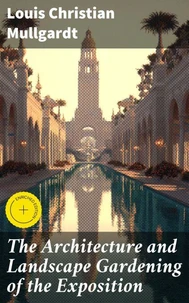
The Architecture and Landscape Gardening of the Exposition. A Pictorial Survey of the Most Beautiful Achitectural Compositions of the Panama-Pacific International Exposition
Par :Formats :
Disponible dans votre compte client Decitre ou Furet du Nord dès validation de votre commande. Le format ePub est :
- Compatible avec une lecture sur My Vivlio (smartphone, tablette, ordinateur)
- Compatible avec une lecture sur liseuses Vivlio
- Pour les liseuses autres que Vivlio, vous devez utiliser le logiciel Adobe Digital Edition. Non compatible avec la lecture sur les liseuses Kindle, Remarkable et Sony
 , qui est-ce ?
Notre partenaire de plateforme de lecture numérique où vous retrouverez l'ensemble de vos ebooks gratuitement
Pour en savoir plus sur nos ebooks, consultez notre aide en ligne ici
C'est si simple ! Lisez votre ebook avec l'app Vivlio sur votre tablette, mobile ou ordinateur :

- Nombre de pages121
- FormatePub
- ISBN859-65--4717789-0
- EAN8596547177890
- Date de parution15/08/2022
- Protection num.Digital Watermarking
- Taille422 Ko
- Infos supplémentairesepub
- ÉditeurDIGICAT
Résumé
In "The Architecture and Landscape Gardening of the Exposition, " Louis Christian Mullgardt presents a comprehensive exploration of the architectural innovations and landscape designs that characterized the early 20th-century exposition. The book meticulously details the aesthetic principles, spatial arrangements, and cultural significances of the structures and gardens that defined the exposition, utilizing a blend of evocative prose and analytical rigor.
Mullgardt engages with contemporary architectural movements, embedding his observations within the broader discourse of landscape architecture, and invites readers to consider the interplay between nature and built environments in shaping public spaces. Louis Christian Mullgardt, a prominent architect and landscape designer himself, was deeply influenced by the arts and crafts movement and the burgeoning American architecture scene of his time.
His first-hand experiences working on the Panama-Pacific International Exposition in 1915 provided him with valuable insights, informing both his theoretical perspectives and practical applications in the book. Mullgardt's appreciation for harmony between nature and structure shines through his examination of the exposition's design philosophy. For anyone intrigued by the nexus of architecture and landscape design, this scholarly work serves as an essential text.
Mullgardt's insights not only enrich our understanding of the exposition but also serve to inspire current and future generations of architects and urban planners. This book is highly recommended for students, professionals, and scholars alike who wish to delve into the legacy and implications of exposition-era design.
Mullgardt engages with contemporary architectural movements, embedding his observations within the broader discourse of landscape architecture, and invites readers to consider the interplay between nature and built environments in shaping public spaces. Louis Christian Mullgardt, a prominent architect and landscape designer himself, was deeply influenced by the arts and crafts movement and the burgeoning American architecture scene of his time.
His first-hand experiences working on the Panama-Pacific International Exposition in 1915 provided him with valuable insights, informing both his theoretical perspectives and practical applications in the book. Mullgardt's appreciation for harmony between nature and structure shines through his examination of the exposition's design philosophy. For anyone intrigued by the nexus of architecture and landscape design, this scholarly work serves as an essential text.
Mullgardt's insights not only enrich our understanding of the exposition but also serve to inspire current and future generations of architects and urban planners. This book is highly recommended for students, professionals, and scholars alike who wish to delve into the legacy and implications of exposition-era design.