
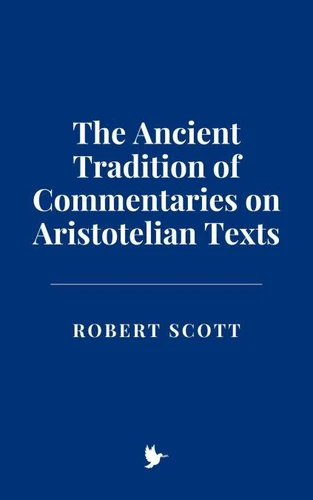
The Ancient Tradition of Commentaries on Aristotelian Texts
Par :Formats :
Disponible dans votre compte client Decitre ou Furet du Nord dès validation de votre commande. Le format ePub est :
- Compatible avec une lecture sur My Vivlio (smartphone, tablette, ordinateur)
- Compatible avec une lecture sur liseuses Vivlio
- Pour les liseuses autres que Vivlio, vous devez utiliser le logiciel Adobe Digital Edition. Non compatible avec la lecture sur les liseuses Kindle, Remarkable et Sony
 , qui est-ce ?
Notre partenaire de plateforme de lecture numérique où vous retrouverez l'ensemble de vos ebooks gratuitement
Pour en savoir plus sur nos ebooks, consultez notre aide en ligne ici
C'est si simple ! Lisez votre ebook avec l'app Vivlio sur votre tablette, mobile ou ordinateur :

- FormatePub
- ISBN8230314615
- EAN9798230314615
- Date de parution01/02/2025
- Protection num.pas de protection
- Infos supplémentairesepub
- ÉditeurIndependently Published
Résumé
This book offers a comprehensive exploration of the enduring legacy of Aristotle's philosophy, tracing his influence across centuries and disciplines. Starting with his foundational contributions to ethics, metaphysics, and logic in ancient Greece, the text follows the transmission and reinterpretation of Aristotle's ideas through the medieval Islamic, Christian, and Renaissance traditions. It examines how thinkers like Al-Farabi, Avicenna, Averroes, Aquinas, and others adapted his works to their respective theological and intellectual contexts, preserving and expanding upon his thoughts.
The book also delves into the rise of early modern philosophy, where figures such as Descartes, Bacon, and Galileo challenged Aristotelian physics but retained his methods of reasoning and logical categorization. Moving through the Enlightenment and into the 19th and 20th centuries, Aristotle's legacy is shown to influence key areas of modern thought, including epistemology, ethics, political theory, and the philosophy of science.
Key thinkers such as Kant, Nietzsche, MacIntyre, and Nussbaum are highlighted for their engagement with Aristotelian ideas, demonstrating their relevance in addressing contemporary ethical dilemmas, human flourishing, and justice. In the contemporary era, Aristotle's concepts continue to provide a framework for discussions in virtue ethics, cognitive science, environmental philosophy, and artificial intelligence.
His ideas on human nature, practical wisdom, and the role of virtue in society remain central to debates on personal morality, social justice, and political governance in a globalized world. Ultimately, the book emphasizes how Aristotle's philosophy, far from being a relic of the past, continues to offer rich insights and tools for grappling with the complexities of the modern world, making his intellectual legacy as relevant today as it was in antiquity.
The book also delves into the rise of early modern philosophy, where figures such as Descartes, Bacon, and Galileo challenged Aristotelian physics but retained his methods of reasoning and logical categorization. Moving through the Enlightenment and into the 19th and 20th centuries, Aristotle's legacy is shown to influence key areas of modern thought, including epistemology, ethics, political theory, and the philosophy of science.
Key thinkers such as Kant, Nietzsche, MacIntyre, and Nussbaum are highlighted for their engagement with Aristotelian ideas, demonstrating their relevance in addressing contemporary ethical dilemmas, human flourishing, and justice. In the contemporary era, Aristotle's concepts continue to provide a framework for discussions in virtue ethics, cognitive science, environmental philosophy, and artificial intelligence.
His ideas on human nature, practical wisdom, and the role of virtue in society remain central to debates on personal morality, social justice, and political governance in a globalized world. Ultimately, the book emphasizes how Aristotle's philosophy, far from being a relic of the past, continues to offer rich insights and tools for grappling with the complexities of the modern world, making his intellectual legacy as relevant today as it was in antiquity.
A propos de Robert Scott
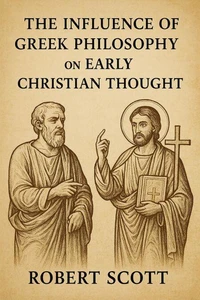


2,99 €

2,99 €


2,99 €


2,99 €

2,99 €

2,99 €

2,99 €


2,99 €

2,99 €