SOLDES
Jusqu'à -70% sur une sélection d'articles*

Nouveauté
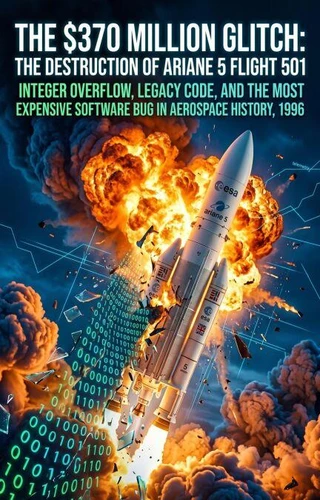
The $370 Million Glitch: The Destruction of Ariane 5 Flight 501. Integer Overflow, Legacy Code, and the Most Expensive Software Bug in Aerospace History, 1996
Par :Formats :
Disponible dans votre compte client Decitre ou Furet du Nord dès validation de votre commande. Le format ePub est :
- Compatible avec une lecture sur My Vivlio (smartphone, tablette, ordinateur)
- Compatible avec une lecture sur liseuses Vivlio
- Pour les liseuses autres que Vivlio, vous devez utiliser le logiciel Adobe Digital Edition. Non compatible avec la lecture sur les liseuses Kindle, Remarkable et Sony
 , qui est-ce ?
Notre partenaire de plateforme de lecture numérique où vous retrouverez l'ensemble de vos ebooks gratuitement
Pour en savoir plus sur nos ebooks, consultez notre aide en ligne ici
C'est si simple ! Lisez votre ebook avec l'app Vivlio sur votre tablette, mobile ou ordinateur :

- Nombre de pages184
- FormatePub
- ISBN978-3-565-46648-1
- EAN9783565466481
- Date de parution29/05/2026
- Protection num.pas de protection
- Taille791 Ko
- Infos supplémentairesepub
- ÉditeurEmphaloz Publishing House
Résumé
How can a decade of brilliant engineering and 370 million dollars of scientific equipment be completely vaporized in exactly 37 seconds due to a single line of faulty computer code? The explosive maiden voyage of the European Space Agency's Ariane 5 rocket in 1996 remains the most infamous and costly software bug in the history of aerospace engineering.
The rocket's catastrophic failure was entirely self-inflicted.
Engineers had lazily reused the inertial reference software from the older, slower Ariane 4 rocket without adequately testing it for the new flight profile. As the vastly more powerful Ariane 5 accelerated, the horizontal velocity value exceeded the maximum limit of a 16-bit integer. The software attempted to cram a 64-bit number into a 16-bit space, triggering a massive "integer overflow." The navigation computer instantly crashed, violently flipped the rocket's nozzles to their extreme limits, and triggered the automatic self-destruct mechanism. This rigorous computer science autopsy explores the brutal unforgiving nature of code.
It documents the cascading failure of the redundancy systems, the absolute necessity of rigorous stress-testing, and the dangerous illusion that "working" legacy code is always safe to reuse. Respect the variables. The Ariane 5 disaster is the ultimate engineering lesson: in the realm of high-velocity physics, a tiny mathematical rounding error is just as lethal as a bomb.
Engineers had lazily reused the inertial reference software from the older, slower Ariane 4 rocket without adequately testing it for the new flight profile. As the vastly more powerful Ariane 5 accelerated, the horizontal velocity value exceeded the maximum limit of a 16-bit integer. The software attempted to cram a 64-bit number into a 16-bit space, triggering a massive "integer overflow." The navigation computer instantly crashed, violently flipped the rocket's nozzles to their extreme limits, and triggered the automatic self-destruct mechanism. This rigorous computer science autopsy explores the brutal unforgiving nature of code.
It documents the cascading failure of the redundancy systems, the absolute necessity of rigorous stress-testing, and the dangerous illusion that "working" legacy code is always safe to reuse. Respect the variables. The Ariane 5 disaster is the ultimate engineering lesson: in the realm of high-velocity physics, a tiny mathematical rounding error is just as lethal as a bomb.