The persistent overshoot of planetary boundaries, despite an intensified discourse on sustainable lifestyles, highlights a structural dilemma. Unsustainability should not be interpreted solely as individual misconduct, but rather as the consequence of an economic system following the linear logic of "take-make-waste".
This book addresses a central question of our time: How can individual consumption decisions exert any influence at all within a system geared toward linearity? The answer lies not merely in renunciation, but in a fundamental transformation toward a Circular Economy - and in a redefinition of the role of consumers.
Not as a passive terminus of value creation, but as active co-shapers of material cycles within the framework of economy, policy, and society.
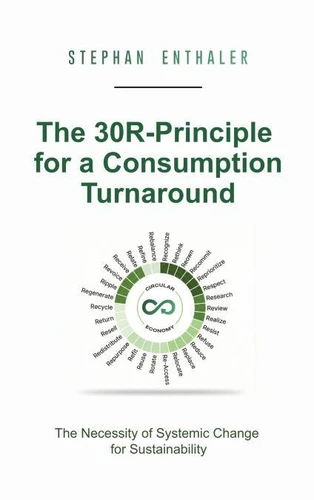
With the 30R-Principle, this book provides a framework for this role. It expands familiar reduction and recycling approaches into a model that integrates thinking, decision-making, and action. From awareness and internal mindset to informed purchasing decisions, through to the use, life extension, and return of products into the cycle, the 30R-Principle demonstrates where and how consumers can achieve systemic leverage.
This is not about isolated individual actions, but about a new logic of resource utilization: a balance of responsibility, efficacy, and quality of life.
By integrating reflection, learning, communication, and collective impact, sustainable consumption evolves from a moral appeal into a manageable practice of action.
A book for everyone who seeks to understand the structural conditions under which consumption practices can become part of a systemic consumption turnaround.
The persistent overshoot of planetary boundaries, despite an intensified discourse on sustainable lifestyles, highlights a structural dilemma. Unsustainability should not be interpreted solely as individual misconduct, but rather as the consequence of an economic system following the linear logic of "take-make-waste".
This book addresses a central question of our time: How can individual consumption decisions exert any influence at all within a system geared toward linearity? The answer lies not merely in renunciation, but in a fundamental transformation toward a Circular Economy - and in a redefinition of the role of consumers.
Not as a passive terminus of value creation, but as active co-shapers of material cycles within the framework of economy, policy, and society.
With the 30R-Principle, this book provides a framework for this role. It expands familiar reduction and recycling approaches into a model that integrates thinking, decision-making, and action. From awareness and internal mindset to informed purchasing decisions, through to the use, life extension, and return of products into the cycle, the 30R-Principle demonstrates where and how consumers can achieve systemic leverage.
This is not about isolated individual actions, but about a new logic of resource utilization: a balance of responsibility, efficacy, and quality of life.
By integrating reflection, learning, communication, and collective impact, sustainable consumption evolves from a moral appeal into a manageable practice of action.
A book for everyone who seeks to understand the structural conditions under which consumption practices can become part of a systemic consumption turnaround.