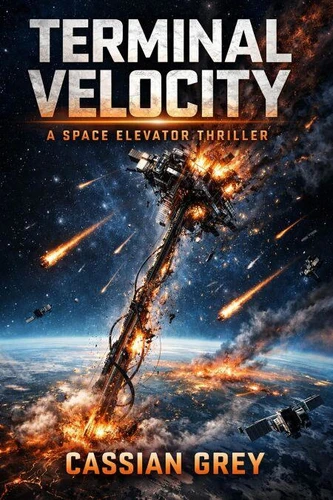
The SkyStem tether was humanity's greatest engineering triumph. Six hundred kilometers of carbon-composite cable stretching from the Indian Ocean to low Earth orbit - lifting cargo, satellites, and the future itself. Then the numbers start to change. Maya Ibarra, an orbital debris analyst in Houston, notices a pattern in the telemetry that no one else seems willing to see. The upper segment of the tether is approaching catastrophic fatigue.
Her models predict failure in days, not months. But the company that built SkyStem insists everything is under control. In orbit, the crew of Kepler Station receives a quiet advisory: monitor the tether for potential debris risk. Military satellites pass through the same orbital corridor. Mission control signs off on daily launch operations. Everyone believes there's still time. They're wrong. If the tether snaps, thousands of kilometers of cable could whip through orbit at terminal velocity, shredding satellites, stations, and spacecraft in a cascade of destruction that could lock humanity out of space for generations.
Now a handful of analysts, astronauts, and operators must decide whether to trust the official models - or the terrifying math that says the collapse has already begun. Because once the cable breaks, gravity will take over. And nothing falling from orbit stops quickly.
The SkyStem tether was humanity's greatest engineering triumph. Six hundred kilometers of carbon-composite cable stretching from the Indian Ocean to low Earth orbit - lifting cargo, satellites, and the future itself. Then the numbers start to change. Maya Ibarra, an orbital debris analyst in Houston, notices a pattern in the telemetry that no one else seems willing to see. The upper segment of the tether is approaching catastrophic fatigue.
Her models predict failure in days, not months. But the company that built SkyStem insists everything is under control. In orbit, the crew of Kepler Station receives a quiet advisory: monitor the tether for potential debris risk. Military satellites pass through the same orbital corridor. Mission control signs off on daily launch operations. Everyone believes there's still time. They're wrong. If the tether snaps, thousands of kilometers of cable could whip through orbit at terminal velocity, shredding satellites, stations, and spacecraft in a cascade of destruction that could lock humanity out of space for generations.
Now a handful of analysts, astronauts, and operators must decide whether to trust the official models - or the terrifying math that says the collapse has already begun. Because once the cable breaks, gravity will take over. And nothing falling from orbit stops quickly.


 , qui est-ce ?
