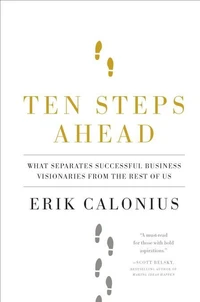
Ten Steps Ahead. What Smart Business People Know That You Don't
Par :Formats :
Disponible dans votre compte client Decitre ou Furet du Nord dès validation de votre commande. Le format ePub protégé est :
- Compatible avec une lecture sur My Vivlio (smartphone, tablette, ordinateur)
- Compatible avec une lecture sur liseuses Vivlio
- Pour les liseuses autres que Vivlio, vous devez utiliser le logiciel Adobe Digital Edition. Non compatible avec la lecture sur les liseuses Kindle, Remarkable et Sony
- Non compatible avec un achat hors France métropolitaine
 , qui est-ce ?
Notre partenaire de plateforme de lecture numérique où vous retrouverez l'ensemble de vos ebooks gratuitement
Pour en savoir plus sur nos ebooks, consultez notre aide en ligne ici
C'est si simple ! Lisez votre ebook avec l'app Vivlio sur votre tablette, mobile ou ordinateur :

- Nombre de pages203
- FormatePub
- ISBN978-0-7553-6236-3
- EAN9780755362363
- Date de parution30/03/2011
- Protection num.Adobe DRM
- Infos supplémentairesepub
- ÉditeurHeadline
Résumé
Business visionaries like Steve Jobs and Richard Branson are the stuff of legend. Yet we fumble in describing what they actually do. TEN STEPS AHEAD explains how it's not that some people can magically see opportunities - it's that the rest of us are blind to the ones all around us. We learn, for instance:How Richard Branson had the foresight to trademark Virgin Galactic in the early 1990s, when private spaceflight was science fiction;How Richard Feynman made breakthroughs in quantum mechanics be pretending he was an electron;Why Jeff Hawkins walked around with a block of wood and a chopstick to design the first Palm Pilot.
Erik Calonius, who has interviewed many of the greatest living visionaries across disciplines and industries, weaves together their stories, highlights their shared attributes, and draws on science to help us understand what sets them apart and how we too can see (and make) the future.
Erik Calonius, who has interviewed many of the greatest living visionaries across disciplines and industries, weaves together their stories, highlights their shared attributes, and draws on science to help us understand what sets them apart and how we too can see (and make) the future.