
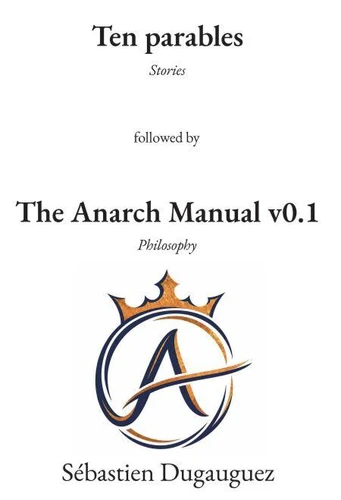
Ten Parables and the Anarch Manual v0.1
Par :Formats :
Disponible dans votre compte client Decitre ou Furet du Nord dès validation de votre commande. Le format ePub est :
- Compatible avec une lecture sur My Vivlio (smartphone, tablette, ordinateur)
- Compatible avec une lecture sur liseuses Vivlio
- Pour les liseuses autres que Vivlio, vous devez utiliser le logiciel Adobe Digital Edition. Non compatible avec la lecture sur les liseuses Kindle, Remarkable et Sony
 , qui est-ce ?
Notre partenaire de plateforme de lecture numérique où vous retrouverez l'ensemble de vos ebooks gratuitement
Pour en savoir plus sur nos ebooks, consultez notre aide en ligne ici
C'est si simple ! Lisez votre ebook avec l'app Vivlio sur votre tablette, mobile ou ordinateur :

- FormatePub
- ISBN979-10-986017-4-3
- EAN9791098601743
- Date de parution09/05/2026
- Protection num.pas de protection
- Infos supplémentairesepub
- ÉditeurSébastien Dugauguez
Résumé
?"The Anarch is to the anarchist what the monarch is to the monarchist."-Ernst Jünger Ten speculative stories open this book like so many doors: A Marseille engineer invents a digital globe. A French president addresses the United Nations to argue for the abolition of inheritance. Lithuania experiments with the first direct democracy. A state organizes a parallel nocturnal society to accommodate millions of refugees...
These ten parables are not ordinary works of speculative fiction: they are thought experiments for a philosophy yet to come. For this is a double book. After the stories comes The Anarch Manual: the outline of a practical philosophy that openly claims its lineage-Epictetus, Spinoza, Stirner, Rand, Hayek-and draws from it an optimistic, contemporary synthesis. The Anarch is not the one who destroys order and the state: he is the one who no longer needs them.
A free and happy man, not because he has conquered his freedom, but because he has come to understand that it was never truly absent. Against the prevailing mood of lament, this book advances a single thesis: the institutions that have long organized our lives-the state, marriage, inheritance, representative democracy-have not failed. They have simply exhausted their historical usefulness. And for each, The Anarch Manual proposes a successor: a freer alternative, designed for the individual who governs himself. What emerges is a rare work of synthesis-one in which Stoic philosophy and Austrian economics, liberal anarchism and the possibilities opened by artificial intelligence, converge in a single voice.
Written by a man who chose to live first, and only afterward to theorize.
These ten parables are not ordinary works of speculative fiction: they are thought experiments for a philosophy yet to come. For this is a double book. After the stories comes The Anarch Manual: the outline of a practical philosophy that openly claims its lineage-Epictetus, Spinoza, Stirner, Rand, Hayek-and draws from it an optimistic, contemporary synthesis. The Anarch is not the one who destroys order and the state: he is the one who no longer needs them.
A free and happy man, not because he has conquered his freedom, but because he has come to understand that it was never truly absent. Against the prevailing mood of lament, this book advances a single thesis: the institutions that have long organized our lives-the state, marriage, inheritance, representative democracy-have not failed. They have simply exhausted their historical usefulness. And for each, The Anarch Manual proposes a successor: a freer alternative, designed for the individual who governs himself. What emerges is a rare work of synthesis-one in which Stoic philosophy and Austrian economics, liberal anarchism and the possibilities opened by artificial intelligence, converge in a single voice.
Written by a man who chose to live first, and only afterward to theorize.
A propos de Sébastien Dugauguez

3,99 €

3,99 €