
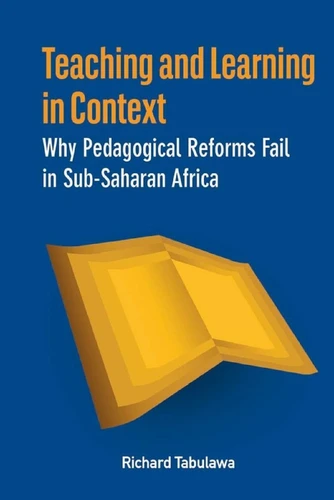
Teaching and Learning in Context - Why Pedagogical Reforms Fail in Sub-Saharan Africa
Par :Formats :
Disponible dans votre compte client Decitre ou Furet du Nord dès validation de votre commande. Le format ePub est :
- Compatible avec une lecture sur My Vivlio (smartphone, tablette, ordinateur)
- Compatible avec une lecture sur liseuses Vivlio
- Pour les liseuses autres que Vivlio, vous devez utiliser le logiciel Adobe Digital Edition. Non compatible avec la lecture sur les liseuses Kindle, Remarkable et Sony
 , qui est-ce ?
Notre partenaire de plateforme de lecture numérique où vous retrouverez l'ensemble de vos ebooks gratuitement
Pour en savoir plus sur nos ebooks, consultez notre aide en ligne ici
C'est si simple ! Lisez votre ebook avec l'app Vivlio sur votre tablette, mobile ou ordinateur :

- Nombre de pages303
- FormatePub
- ISBN978-2-86978-569-4
- EAN9782869785694
- Date de parution26/10/2022
- Protection num.Digital Watermarking
- Taille440 Ko
- Infos supplémentairesepub
- ÉditeurCODESRIA
Résumé
Since the 1990s, sub-Saharan Africa has experienced unprecedented attempts at reforming teacher and student classroom practices, with a learner-centred pedagogy regarded as an effective antidote to the prevalence of teacher-centred didactic classroom practices. Attempts at reform have been going on all over the continent. In fact, learner-centred pedagogy has been described as one of the most pervasive educational ideas in contemporary sub-Saharan Africa and elsewhere.
Research has revealed that the major attempts have largely failed mainly because teachers have not been able to adopt instructional innovations to technical problems. This failure is also related to lack of resources, and poor teacher training programmes which lead to poor teacher quality, among others. This book attempts to explain why pedagogical change has not occurred in spite of the much energy and resources that have been committed to such reforms.
The book also takes us inside what the author calls 'the socio-cultural world of African classrooms' to help us understand the reasons teachers dominate classroom life and rely disproportionately on didactic methods of teaching. Its conceptual analyses capture the best of both the sociology and the anthropology of education in contexts of poverty, as well as the politics of education. The book concludes that a socio-cultural approach should be the basis for developing culturally responsive indigenous pedagogies, though these may or may not turn out to be in any way akin to constructivist learner-centred pedagogies.
Research has revealed that the major attempts have largely failed mainly because teachers have not been able to adopt instructional innovations to technical problems. This failure is also related to lack of resources, and poor teacher training programmes which lead to poor teacher quality, among others. This book attempts to explain why pedagogical change has not occurred in spite of the much energy and resources that have been committed to such reforms.
The book also takes us inside what the author calls 'the socio-cultural world of African classrooms' to help us understand the reasons teachers dominate classroom life and rely disproportionately on didactic methods of teaching. Its conceptual analyses capture the best of both the sociology and the anthropology of education in contexts of poverty, as well as the politics of education. The book concludes that a socio-cultural approach should be the basis for developing culturally responsive indigenous pedagogies, though these may or may not turn out to be in any way akin to constructivist learner-centred pedagogies.