
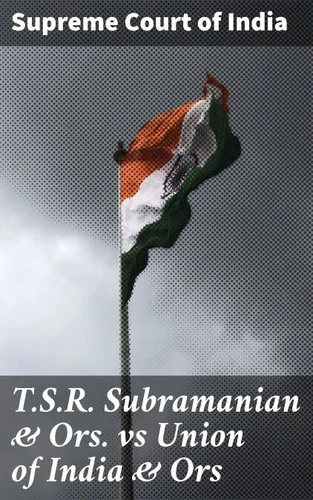
T.S.R. Subramanian & Ors. vs Union of India & Ors. Exploring Environmental Law and Policy in India's Supreme Court
Par :Formats :
Disponible dans votre compte client Decitre ou Furet du Nord dès validation de votre commande. Le format ePub est :
- Compatible avec une lecture sur My Vivlio (smartphone, tablette, ordinateur)
- Compatible avec une lecture sur liseuses Vivlio
- Pour les liseuses autres que Vivlio, vous devez utiliser le logiciel Adobe Digital Edition. Non compatible avec la lecture sur les liseuses Kindle, Remarkable et Sony
 , qui est-ce ?
Notre partenaire de plateforme de lecture numérique où vous retrouverez l'ensemble de vos ebooks gratuitement
Pour en savoir plus sur nos ebooks, consultez notre aide en ligne ici
C'est si simple ! Lisez votre ebook avec l'app Vivlio sur votre tablette, mobile ou ordinateur :

- Nombre de pages25
- FormatePub
- ISBN406-4-06-606489-1
- EAN4064066064891
- Date de parution08/12/2020
- Protection num.Digital Watermarking
- Taille553 Ko
- Infos supplémentairesepub
- ÉditeurGOOD PRESS
Résumé
In "T. S. R. Subramanian & Ors. vs Union of India & Ors, " the Supreme Court of India provides an intricate analysis of constitutional governance through a landmark judgement that addressed the delicate balance of power between the executive and judicial branches. The text employs a legalistic yet accessible literary style, characterized by meticulous reasoning and eloquent prose. It situates itself within the broader context of Indian constitutional law, examining the implications of bureaucratic norms, the sanctity of public interest, and the role of accountability in governance.
This judgement is not merely a document of law; it reflects the evolving narrative of democracy in India. The Supreme Court of India, as a venerated institution in the Indian judiciary, carries a historical legacy that influences its rulings. This case, involving prominent civil service figures like T. S. R. Subramanian, may have arisen from personal and collective experiences in public administration as well as the pressing need to uphold constitutional mandates.
The court's judgments often serve as a reflection of societal values and aspirations, illustrating the judiciary's role in maintaining the rule of law. Readers interested in constitutional law, governance, and the judiciary will find this judgement not only a fundamental resource for study but also a powerful exposition of the principles that underpin Indian democracy. It invites scholars, legal practitioners, and citizens alike to engage with the complexities of administrative conduct and the overarching necessity of safeguarding public interest.
This judgement is not merely a document of law; it reflects the evolving narrative of democracy in India. The Supreme Court of India, as a venerated institution in the Indian judiciary, carries a historical legacy that influences its rulings. This case, involving prominent civil service figures like T. S. R. Subramanian, may have arisen from personal and collective experiences in public administration as well as the pressing need to uphold constitutional mandates.
The court's judgments often serve as a reflection of societal values and aspirations, illustrating the judiciary's role in maintaining the rule of law. Readers interested in constitutional law, governance, and the judiciary will find this judgement not only a fundamental resource for study but also a powerful exposition of the principles that underpin Indian democracy. It invites scholars, legal practitioners, and citizens alike to engage with the complexities of administrative conduct and the overarching necessity of safeguarding public interest.