
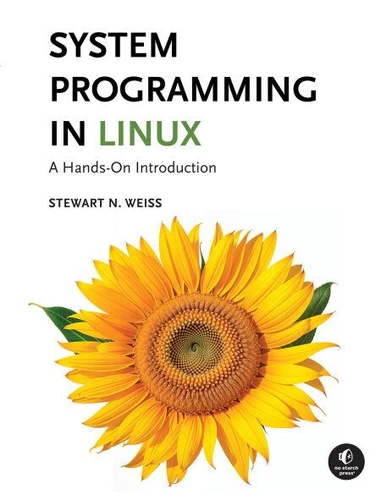
System Programming in Linux. A Hands-On Introduction
Par :Formats :
Disponible dans votre compte client Decitre ou Furet du Nord dès validation de votre commande. Le format ePub est :
- Compatible avec une lecture sur My Vivlio (smartphone, tablette, ordinateur)
- Compatible avec une lecture sur liseuses Vivlio
- Pour les liseuses autres que Vivlio, vous devez utiliser le logiciel Adobe Digital Edition. Non compatible avec la lecture sur les liseuses Kindle, Remarkable et Sony
 , qui est-ce ?
Notre partenaire de plateforme de lecture numérique où vous retrouverez l'ensemble de vos ebooks gratuitement
Pour en savoir plus sur nos ebooks, consultez notre aide en ligne ici
C'est si simple ! Lisez votre ebook avec l'app Vivlio sur votre tablette, mobile ou ordinateur :

- Nombre de pages1048
- FormatePub
- ISBN978-1-7185-0357-1
- EAN9781718503571
- Date de parution14/10/2025
- Protection num.pas de protection
- Taille25 Mo
- Infos supplémentairesepub
- ÉditeurNo Starch Press
Résumé
Learn to write real Linux software-not just run it. Most programmers never learn how Linux really works. Why? Because system programming is rarely taught, and the tools can be intimidating without the right guidance. As a result, many developers stick to high-level languages and frameworks-writing code that runs on Linux without understanding how it interacts with Linux. In today's world, that's not enough to stand out.
Especially as more companies turn to AI to write their software, the question becomes: How do you stay relevant in an AI-driven world? You learn how things really work. If you've ever wondered how processes are created, how memory and files are managed, or how programs communicate in a Unix environment, System Programming in Linux will make it all make sense. This is a hands-on guide to writing software that interfaces directly with the Linux operating system.
You'll go beyond shell commands and abstractions to understand what the kernel is doing-and how to leverage it through your own code. Rather than telling you how to solve each problem, Professor Stewart N. Weiss guides you through the process of discovering the solution yourself. Start with the core concepts of Unix and Linux, then work your way up to advanced topics like process control, signals, interprocess communication, threading, and non-blocking I/O.
Each chapter includes conceptual diagrams, annotated source code, and practical projects to help you immediately apply what you've learned. You'll explore topics such as: The structure of Unix and Linux operating systems-and why it matters Using system calls to create and manage processes The mechanics of signals, timers, and interprocess communication Using synchronization tools to write multithreaded programs Interacting with filesystems, devices, and terminals Building text-based user interfaces using ncurses Developing programs that are robust, efficient, and portable At Hunter College, Professor Weiss built the course this book is based on, and he has helped thousands of students go from confusion to confidence in his over 40 years of teaching programming.
His clear, conversational style; technical depth; and focus on real-world application make this one of the most approachable and powerful system programming books available. As Linux continues to dominate development, server, and embedded environments, understanding the system behind your software isn't just helpful; it's essential. Whether you're a student, developer, or sysadmin, this book gives you the tools to work directly with Linux and the insight to understand what's really happening under the hood.
Especially as more companies turn to AI to write their software, the question becomes: How do you stay relevant in an AI-driven world? You learn how things really work. If you've ever wondered how processes are created, how memory and files are managed, or how programs communicate in a Unix environment, System Programming in Linux will make it all make sense. This is a hands-on guide to writing software that interfaces directly with the Linux operating system.
You'll go beyond shell commands and abstractions to understand what the kernel is doing-and how to leverage it through your own code. Rather than telling you how to solve each problem, Professor Stewart N. Weiss guides you through the process of discovering the solution yourself. Start with the core concepts of Unix and Linux, then work your way up to advanced topics like process control, signals, interprocess communication, threading, and non-blocking I/O.
Each chapter includes conceptual diagrams, annotated source code, and practical projects to help you immediately apply what you've learned. You'll explore topics such as: The structure of Unix and Linux operating systems-and why it matters Using system calls to create and manage processes The mechanics of signals, timers, and interprocess communication Using synchronization tools to write multithreaded programs Interacting with filesystems, devices, and terminals Building text-based user interfaces using ncurses Developing programs that are robust, efficient, and portable At Hunter College, Professor Weiss built the course this book is based on, and he has helped thousands of students go from confusion to confidence in his over 40 years of teaching programming.
His clear, conversational style; technical depth; and focus on real-world application make this one of the most approachable and powerful system programming books available. As Linux continues to dominate development, server, and embedded environments, understanding the system behind your software isn't just helpful; it's essential. Whether you're a student, developer, or sysadmin, this book gives you the tools to work directly with Linux and the insight to understand what's really happening under the hood.