SOLDES
Jusqu'à -70% sur une sélection d'articles*

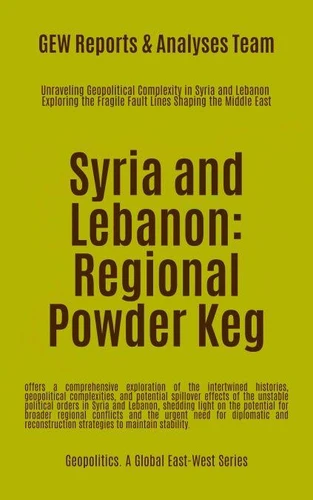
Syria and Lebanon: Regional Powder Keg. Geopolitics
Par :Formats :
Disponible dans votre compte client Decitre ou Furet du Nord dès validation de votre commande. Le format ePub protégé est :
- Compatible avec une lecture sur My Vivlio (smartphone, tablette, ordinateur)
- Compatible avec une lecture sur liseuses Vivlio
- Pour les liseuses autres que Vivlio, vous devez utiliser le logiciel Adobe Digital Edition. Non compatible avec la lecture sur les liseuses Kindle, Remarkable et Sony
- Non compatible avec un achat hors France métropolitaine
 , qui est-ce ?
Notre partenaire de plateforme de lecture numérique où vous retrouverez l'ensemble de vos ebooks gratuitement
Pour en savoir plus sur nos ebooks, consultez notre aide en ligne ici
C'est si simple ! Lisez votre ebook avec l'app Vivlio sur votre tablette, mobile ou ordinateur :

- FormatePub
- ISBN8231910779
- EAN9798231910779
- Date de parution19/08/2025
- Protection num.Adobe DRM
- Infos supplémentairesepub
- ÉditeurWalzone Press
Résumé
Syria and Lebanon: Regional Powder KegSyria and Lebanon share deeply intertwined histories shaped by alliances, conflicts, and a common cultural heritage. Today, they stand at the epicentre of one of the Middle East's most volatile landscapes, where fragile political orders threaten to ignite far wider regional crises. This essay explores how instability in these two nations acts as a microcosm of the broader Middle Eastern struggle, revealing the interplay of geopolitical rivalries, sectarian divides, and historical grievances.
Syria's brutal civil war-beginning in 2011-has drawn in Russia, Iran, Turkey, the United States, Israel, and Gulf states, turning the country into a dangerous arena for great power competition. The Assad regime's survival, reliant on foreign backing, has cemented new regional fault lines. Lebanon's fragile sectarian power-sharing system faces unprecedented strain from economic meltdown, governance collapse, and the aftermath of the 2020 Beirut port explosion.
Non-state actors, particularly Hezbollah, have filled the vacuum-blending political influence with armed capabilities. Hezbollah's alignment with Iran and tense rivalry with Israel creates one of the region's most dangerous flashpoints, with even limited clashes risking escalation into multi-front war involving external powers. Refugee pressures-Lebanon hosts the world's highest per capita refugee population-fuel social and political instability.
Shared water resources with neighbours such as Turkey, Israel, and Jordan add further stress, with climate change worsening scarcity and competition. Economic breakdowns in both countries ripple across the Eastern Mediterranean, while Sunni-Shia divides threaten to spread conflict to Iraq, Bahrain, Yemen, and beyond. By analysing the internal, regional, and international dynamics at play, this work provides critical insight into why Syria and Lebanon remain a regional powder keg-and offers scenarios for the future, from escalation to potential paths toward stability through diplomacy, reconstruction, and governance reform.
Syria's brutal civil war-beginning in 2011-has drawn in Russia, Iran, Turkey, the United States, Israel, and Gulf states, turning the country into a dangerous arena for great power competition. The Assad regime's survival, reliant on foreign backing, has cemented new regional fault lines. Lebanon's fragile sectarian power-sharing system faces unprecedented strain from economic meltdown, governance collapse, and the aftermath of the 2020 Beirut port explosion.
Non-state actors, particularly Hezbollah, have filled the vacuum-blending political influence with armed capabilities. Hezbollah's alignment with Iran and tense rivalry with Israel creates one of the region's most dangerous flashpoints, with even limited clashes risking escalation into multi-front war involving external powers. Refugee pressures-Lebanon hosts the world's highest per capita refugee population-fuel social and political instability.
Shared water resources with neighbours such as Turkey, Israel, and Jordan add further stress, with climate change worsening scarcity and competition. Economic breakdowns in both countries ripple across the Eastern Mediterranean, while Sunni-Shia divides threaten to spread conflict to Iraq, Bahrain, Yemen, and beyond. By analysing the internal, regional, and international dynamics at play, this work provides critical insight into why Syria and Lebanon remain a regional powder keg-and offers scenarios for the future, from escalation to potential paths toward stability through diplomacy, reconstruction, and governance reform.
A propos de GEW Reports & Analyses Team.


16,49 €


16,49 €

16,99 €

10,49 €

Strait of Tensions
E-book
11,99 €

9,49 €


Defying Empire
E-book
8,49 €

9,49 €

9,49 €

9,49 €


Unplugged
E-book
9,49 €