
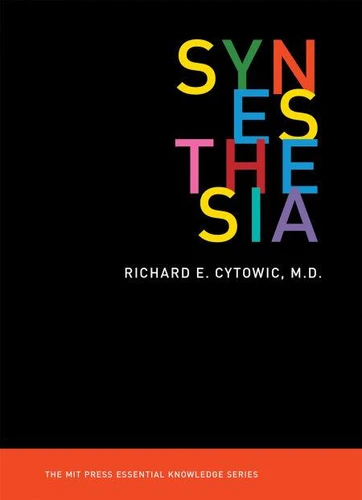
Synesthesia
Par :Formats :
Disponible dans votre compte client Decitre ou Furet du Nord dès validation de votre commande. Le format ePub protégé est :
- Compatible avec une lecture sur My Vivlio (smartphone, tablette, ordinateur)
- Compatible avec une lecture sur liseuses Vivlio
- Pour les liseuses autres que Vivlio, vous devez utiliser le logiciel Adobe Digital Edition. Non compatible avec la lecture sur les liseuses Kindle, Remarkable et Sony
- Non compatible avec un achat hors France métropolitaine
 , qui est-ce ?
Notre partenaire de plateforme de lecture numérique où vous retrouverez l'ensemble de vos ebooks gratuitement
Pour en savoir plus sur nos ebooks, consultez notre aide en ligne ici
C'est si simple ! Lisez votre ebook avec l'app Vivlio sur votre tablette, mobile ou ordinateur :

- Nombre de pages288
- FormatePub
- ISBN978-0-262-34629-0
- EAN9780262346290
- Date de parution09/03/2018
- Protection num.Adobe DRM
- Taille3 Mo
- Infos supplémentairesepub
- ÉditeurThe MIT Press
Résumé
An accessible, concise primer on the neurological trait of synesthesia-vividly felt sensory couplings-by a founder of the field. One in twenty-three people carry the genes for the synesthesia. Not a disorder but a neurological trait-like perfect pitch-synesthesia creates vividly felt cross-sensory couplings. A synesthete might hear a voice and at the same time see it as a color or shape, taste its distinctive flavor, or feel it as a physical touch.
In this volume in the MIT Press Essential Knowledge series, Richard Cytowic, the expert who returned synesthesia to mainstream science after decades of oblivion, offers a concise, accessible primer on this fascinating human experience. Cytowic explains that synesthesia's most frequent manifestation is seeing days of the week as colored, followed by sensing letters, numerals, and punctuation marks in different hues even when printed in black.
Other manifestations include tasting food in shapes, seeing music in moving colors, and mapping numbers and other sequences spatially. One synesthete declares, "Chocolate smells pink and sparkly"; another invents a dish (chicken, vanilla ice cream, and orange juice concentrate) that tastes intensely blue. Cytowic, who in the 1980s revived scientific interest in synesthesia, sees it now understood as a spectrum, an umbrella term that covers five clusters of outwardly felt couplings that can occur via several pathways.
Yet synesthetic or not, each brain uniquely filters what it perceives. Cytowic reminds us that each individual's perspective on the world is thoroughly subjective.
In this volume in the MIT Press Essential Knowledge series, Richard Cytowic, the expert who returned synesthesia to mainstream science after decades of oblivion, offers a concise, accessible primer on this fascinating human experience. Cytowic explains that synesthesia's most frequent manifestation is seeing days of the week as colored, followed by sensing letters, numerals, and punctuation marks in different hues even when printed in black.
Other manifestations include tasting food in shapes, seeing music in moving colors, and mapping numbers and other sequences spatially. One synesthete declares, "Chocolate smells pink and sparkly"; another invents a dish (chicken, vanilla ice cream, and orange juice concentrate) that tastes intensely blue. Cytowic, who in the 1980s revived scientific interest in synesthesia, sees it now understood as a spectrum, an umbrella term that covers five clusters of outwardly felt couplings that can occur via several pathways.
Yet synesthetic or not, each brain uniquely filters what it perceives. Cytowic reminds us that each individual's perspective on the world is thoroughly subjective.