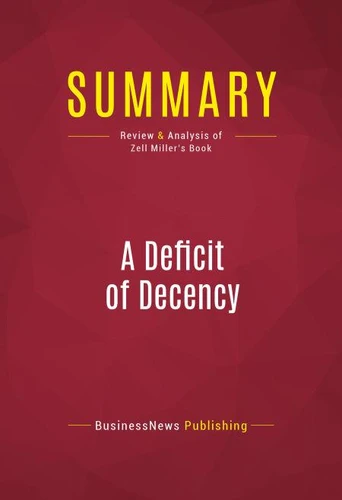
Summary: A Deficit of Decency. Review and Analysis of Zell Miller's Book
Par :Formats :
Disponible dans votre compte client Decitre ou Furet du Nord dès validation de votre commande. Le format ePub est :
- Compatible avec une lecture sur My Vivlio (smartphone, tablette, ordinateur)
- Compatible avec une lecture sur liseuses Vivlio
- Pour les liseuses autres que Vivlio, vous devez utiliser le logiciel Adobe Digital Edition. Non compatible avec la lecture sur les liseuses Kindle, Remarkable et Sony
 , qui est-ce ?
Notre partenaire de plateforme de lecture numérique où vous retrouverez l'ensemble de vos ebooks gratuitement
Pour en savoir plus sur nos ebooks, consultez notre aide en ligne ici
C'est si simple ! Lisez votre ebook avec l'app Vivlio sur votre tablette, mobile ou ordinateur :

- FormatePub
- ISBN978-2-511-00301-5
- EAN9782511003015
- Date de parution30/01/2017
- Protection num.pas de protection
- Infos supplémentairesepub
- ÉditeurPolitical Book Summaries
Résumé
The must-read summary of Zell Miller's book: "A Deficit of Decency". This complete summary of "A Deficit of Decency" by Zell Miller presents a comprehensive overview of the author's reasons for switching his party allegiance from Democrat to Republican in the run-up to the 2004 presidential election. His book discusses what he feels are the increasingly distant values of the Democratic party from the traditional Christian values that form the basis of American society.
The summary outlines his sentiments on the party's "smothering" secularism and his worries as to its national defense and fiscal policies. Added-value of this summary:. Save time. Understand Miller's view of the Democrats and secularism in society. Expand your knowledge of American politics and societyTo learn more, read "A Deficit of Decency" and discover Zell Miller's detailed reasons for his change of political allegiance and his theories on the Democratic party's increasing distance from traditional societal values.
The summary outlines his sentiments on the party's "smothering" secularism and his worries as to its national defense and fiscal policies. Added-value of this summary:. Save time. Understand Miller's view of the Democrats and secularism in society. Expand your knowledge of American politics and societyTo learn more, read "A Deficit of Decency" and discover Zell Miller's detailed reasons for his change of political allegiance and his theories on the Democratic party's increasing distance from traditional societal values.