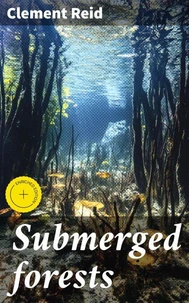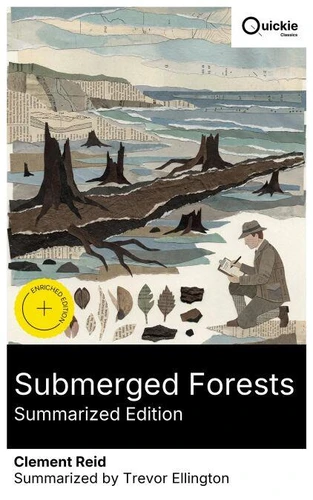
Submerged Forests (Summarized Edition). Enriched edition. Submerged archaeology of ancient ecosystems: hidden landscapes, climate change insights, and environmental history for forest conservation
Par : , ,Formats :
Disponible dans votre compte client Decitre ou Furet du Nord dès validation de votre commande. Le format ePub est :
- Compatible avec une lecture sur My Vivlio (smartphone, tablette, ordinateur)
- Compatible avec une lecture sur liseuses Vivlio
- Pour les liseuses autres que Vivlio, vous devez utiliser le logiciel Adobe Digital Edition. Non compatible avec la lecture sur les liseuses Kindle, Remarkable et Sony
 , qui est-ce ?
Notre partenaire de plateforme de lecture numérique où vous retrouverez l'ensemble de vos ebooks gratuitement
Pour en savoir plus sur nos ebooks, consultez notre aide en ligne ici
C'est si simple ! Lisez votre ebook avec l'app Vivlio sur votre tablette, mobile ou ordinateur :

- Nombre de pages56
- FormatePub
- ISBN859-65--4788123-0
- EAN8596547881230
- Date de parution10/01/2026
- Protection num.Digital Watermarking
- Taille782 Ko
- Infos supplémentairesepub
- ÉditeurQUICKIE CLASSICS
Résumé
Submerged Forests distills coastal observation into a rigorous synthesis, tracing drowned tree stumps and peat beds that fringe Britain's shores. From case studies of rooted stumps in situ within peat and estuarine silts, Reid reconstructs post-glacial shoreline migration and sea-level change, using stratigraphic sections, plant macrofossils, and occasional artefacts to date phases from late Pleistocene to early Holocene.
Written in measured, lucid field prose, it situates coastal peats within debates on eustasy, isostasy, and marine erosion. Clement Reid, geologist and palaeobotanist with the Geological Survey of the United Kingdom, brought a rare synthesis of botanical acuity and coastal mapping to the subject. Collaboration with Eleanor Mary Reid on fossil seeds honed his capacity to read peat deposits as time-series.
Years on the Cromer Forest-bed and receding shores supplied the empirical foundation, and his interest in Britain's former land connections framed the book's broader inferences. This classic rewards geologists, archaeologists, and environmental historians seeking a clear, data-rich account of Holocene shoreline change. It remains an exemplary model of how to build large narratives from humble evidence.
Read it for its method: a concise, lucid lesson in making landscapes speak across deep time. Quickie Classics summarizes timeless works with precision, preserving the author's voice and keeping the prose clear, fast, and readable-distilled, never diluted. Enriched Edition extras: Introduction · Synopsis · Historical Context · Brief Analysis · 4 Reflection Q&As · Editorial Footnotes.
Written in measured, lucid field prose, it situates coastal peats within debates on eustasy, isostasy, and marine erosion. Clement Reid, geologist and palaeobotanist with the Geological Survey of the United Kingdom, brought a rare synthesis of botanical acuity and coastal mapping to the subject. Collaboration with Eleanor Mary Reid on fossil seeds honed his capacity to read peat deposits as time-series.
Years on the Cromer Forest-bed and receding shores supplied the empirical foundation, and his interest in Britain's former land connections framed the book's broader inferences. This classic rewards geologists, archaeologists, and environmental historians seeking a clear, data-rich account of Holocene shoreline change. It remains an exemplary model of how to build large narratives from humble evidence.
Read it for its method: a concise, lucid lesson in making landscapes speak across deep time. Quickie Classics summarizes timeless works with precision, preserving the author's voice and keeping the prose clear, fast, and readable-distilled, never diluted. Enriched Edition extras: Introduction · Synopsis · Historical Context · Brief Analysis · 4 Reflection Q&As · Editorial Footnotes.