
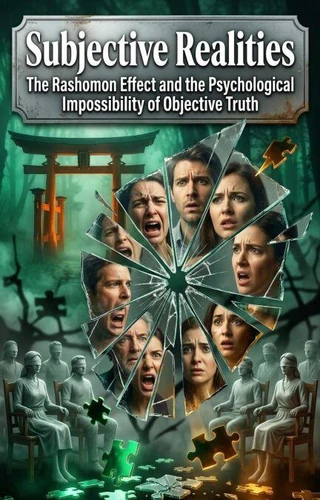
Subjective Realities. The Rashomon Effect and the Psychological Impossibility of Objective Truth
Par :Formats :
Disponible dans votre compte client Decitre ou Furet du Nord dès validation de votre commande. Le format ePub est :
- Compatible avec une lecture sur My Vivlio (smartphone, tablette, ordinateur)
- Compatible avec une lecture sur liseuses Vivlio
- Pour les liseuses autres que Vivlio, vous devez utiliser le logiciel Adobe Digital Edition. Non compatible avec la lecture sur les liseuses Kindle, Remarkable et Sony
 , qui est-ce ?
Notre partenaire de plateforme de lecture numérique où vous retrouverez l'ensemble de vos ebooks gratuitement
Pour en savoir plus sur nos ebooks, consultez notre aide en ligne ici
C'est si simple ! Lisez votre ebook avec l'app Vivlio sur votre tablette, mobile ou ordinateur :

- Nombre de pages161
- FormatePub
- ISBN978-3-565-30623-7
- EAN9783565306237
- Date de parution09/03/2026
- Protection num.pas de protection
- Taille769 Ko
- Infos supplémentairesepub
- ÉditeurEmphaloz Publishing House
Résumé
If four people witness the exact same event, why do they often recount four completely different, mutually exclusive stories? This is the Rashomon Effect, a psychological phenomenon where subjective perceptions fundamentally alter the recording of objective reality. It is not a matter of intentional lying, but a profound flaw in the neurological machinery of human memory and perception.
This book explores the terrifying implications of subjective truth across various facets of society.
From the unreliability of eyewitness testimonies in high-stakes criminal trials to the breakdown of communication in personal relationships, the narrative reveals how our biases, past traumas, and emotional states rewrite history in real-time. It explains the neuroscience of memory consolidation, proving that every time we recall an event, we unconsciously alter it. By accepting the reality of the Rashomon Effect, we can approach conflicts with greater empathy and analytical rigor.
Learn how to identify your own perceptive biases, navigate disputes involving conflicting truths, and understand the fragile, reconstructed nature of human memory.
From the unreliability of eyewitness testimonies in high-stakes criminal trials to the breakdown of communication in personal relationships, the narrative reveals how our biases, past traumas, and emotional states rewrite history in real-time. It explains the neuroscience of memory consolidation, proving that every time we recall an event, we unconsciously alter it. By accepting the reality of the Rashomon Effect, we can approach conflicts with greater empathy and analytical rigor.
Learn how to identify your own perceptive biases, navigate disputes involving conflicting truths, and understand the fragile, reconstructed nature of human memory.