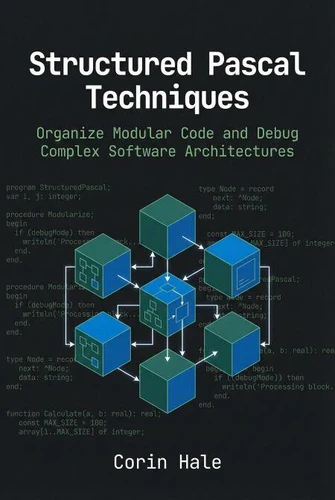
Structured Pascal Techniques: Organize Modular Code and Debug Complex Software Architectures. Practical Systems Programming with Pascal, #2
Par :Formats :
Disponible dans votre compte client Decitre ou Furet du Nord dès validation de votre commande. Le format ePub protégé est :
- Compatible avec une lecture sur My Vivlio (smartphone, tablette, ordinateur)
- Compatible avec une lecture sur liseuses Vivlio
- Pour les liseuses autres que Vivlio, vous devez utiliser le logiciel Adobe Digital Edition. Non compatible avec la lecture sur les liseuses Kindle, Remarkable et Sony
- Non compatible avec un achat hors France métropolitaine
 , qui est-ce ?
Notre partenaire de plateforme de lecture numérique où vous retrouverez l'ensemble de vos ebooks gratuitement
Pour en savoir plus sur nos ebooks, consultez notre aide en ligne ici
C'est si simple ! Lisez votre ebook avec l'app Vivlio sur votre tablette, mobile ou ordinateur :

- FormatePub
- ISBN8233727696
- EAN9798233727696
- Date de parution05/03/2026
- Protection num.Adobe DRM
- Infos supplémentairesepub
- ÉditeurLinda Balsamo
Résumé
Move beyond syntax and start engineering software that lasts. Knowing how to write a loop or declare a variable is just the beginning. When your Pascal programs start growing in size, the real challenge is keeping them organized, readable, and free from cascading failures. Structured Pascal Techniques is the definitive guide for developers ready to cross the boundary from script writer to software architect.
Rooted in the foundational principles of structured programming, this book teaches you how to design Pascal software using the same disciplined techniques used in professional systems development. You will learn to think in modules, reason about data at the architectural level, and build codebases that can evolve over years without falling apart. What this book covers: Structured control flow, guard clauses, and finite state machines Domain-driven type design with subranges, enumerated types, and complex records Pointer mechanics, dynamic data structures, and Abstract Data Types Pascal Units: designing minimalist APIs, hiding state, and managing dependencies Cohesion and coupling metrics for evaluating architecture quality Layered architecture for separating business logic, data, and interface tiers Defensive programming, preconditions, postconditions, and error handling Advanced debugging: tracing execution, isolating memory leaks, and inspecting state Refactoring legacy code and managing enterprise-scale Pascal projects Every chapter is built around real, compilable code examples and practical exercises that train you to think architecturally before writing a single line.
If you are an intermediate Pascal developer who wants to write code that is genuinely professional, this book is your next step.
Rooted in the foundational principles of structured programming, this book teaches you how to design Pascal software using the same disciplined techniques used in professional systems development. You will learn to think in modules, reason about data at the architectural level, and build codebases that can evolve over years without falling apart. What this book covers: Structured control flow, guard clauses, and finite state machines Domain-driven type design with subranges, enumerated types, and complex records Pointer mechanics, dynamic data structures, and Abstract Data Types Pascal Units: designing minimalist APIs, hiding state, and managing dependencies Cohesion and coupling metrics for evaluating architecture quality Layered architecture for separating business logic, data, and interface tiers Defensive programming, preconditions, postconditions, and error handling Advanced debugging: tracing execution, isolating memory leaks, and inspecting state Refactoring legacy code and managing enterprise-scale Pascal projects Every chapter is built around real, compilable code examples and practical exercises that train you to think architecturally before writing a single line.
If you are an intermediate Pascal developer who wants to write code that is genuinely professional, this book is your next step.