"The original is missing." In the corporate-saturated landscape of Stop Button, author V. K. Static introduces us to Elias, a man whose "factory" is his skull and whose product is human feeling. As a board-certified specialist in borrowed conviction, Elias spends his days ghostwriting radical vulnerability for wellness influencers and "thought leaders" who cannot produce their own emotions. The narrative follows Elias as he experiences a "record of malfunction, " beginning with a spontaneous, unscripted animal bark that shatters his polished professional veneer.
This glitch triggers a series of obsessive clinical experiments: The Mask Inventory: A detailed catalogue of the curated personas Elias deploys for clients, family, and even when he is alone. Mirror Protocol: An experiment in social reciprocity where Elias gives back exactly what he receives, discovering that no one-including himself-notices the lack of a genuine person behind the surface. The Bark Economy: A dark satire on corporate language, where Elias discovers that animal noises are as metabolically useful to the market as buzzwords like "synergy" and "leverage".
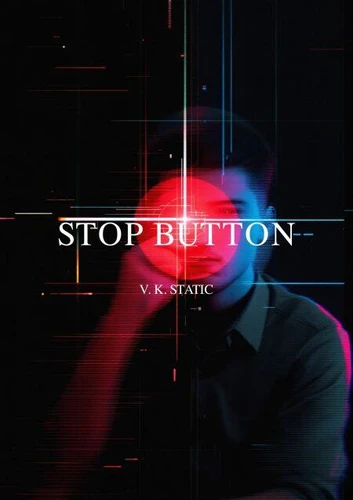
Identity Swaps: A thirty-day protocol with a neighbor where the two men trade lives, only to find their identities are interchangeable, corrupted files. Told through a blend of "field notes, " technical transcripts, and "system diagnostics, " Stop Button uses the metaphor of a degrading VCR tape to mirror Elias's psychological signal loss. It is a stark reflection on the digital age, where the "map has eaten the territory, " and the search for an original self might lead to a blank tape. Perfect for fans of postmodern fiction and psychological thrillers, this book explores the terrifying possibility that our lives have become a series of six rehearsed moves, and the only honest response left is to finally press [[ STOP ]].
"The original is missing." In the corporate-saturated landscape of Stop Button, author V. K. Static introduces us to Elias, a man whose "factory" is his skull and whose product is human feeling. As a board-certified specialist in borrowed conviction, Elias spends his days ghostwriting radical vulnerability for wellness influencers and "thought leaders" who cannot produce their own emotions. The narrative follows Elias as he experiences a "record of malfunction, " beginning with a spontaneous, unscripted animal bark that shatters his polished professional veneer.
This glitch triggers a series of obsessive clinical experiments: The Mask Inventory: A detailed catalogue of the curated personas Elias deploys for clients, family, and even when he is alone. Mirror Protocol: An experiment in social reciprocity where Elias gives back exactly what he receives, discovering that no one-including himself-notices the lack of a genuine person behind the surface. The Bark Economy: A dark satire on corporate language, where Elias discovers that animal noises are as metabolically useful to the market as buzzwords like "synergy" and "leverage".
Identity Swaps: A thirty-day protocol with a neighbor where the two men trade lives, only to find their identities are interchangeable, corrupted files. Told through a blend of "field notes, " technical transcripts, and "system diagnostics, " Stop Button uses the metaphor of a degrading VCR tape to mirror Elias's psychological signal loss. It is a stark reflection on the digital age, where the "map has eaten the territory, " and the search for an original self might lead to a blank tape. Perfect for fans of postmodern fiction and psychological thrillers, this book explores the terrifying possibility that our lives have become a series of six rehearsed moves, and the only honest response left is to finally press [[ STOP ]].


 , qui est-ce ?
